Housing literacy
Renting in Korea for 3–6 months: your realistic options
Korea advertises 12-month leases, but a 3–6 month stay has five real options. Here is what each one costs, what legal protection it carries, and how to secure one from abroad.
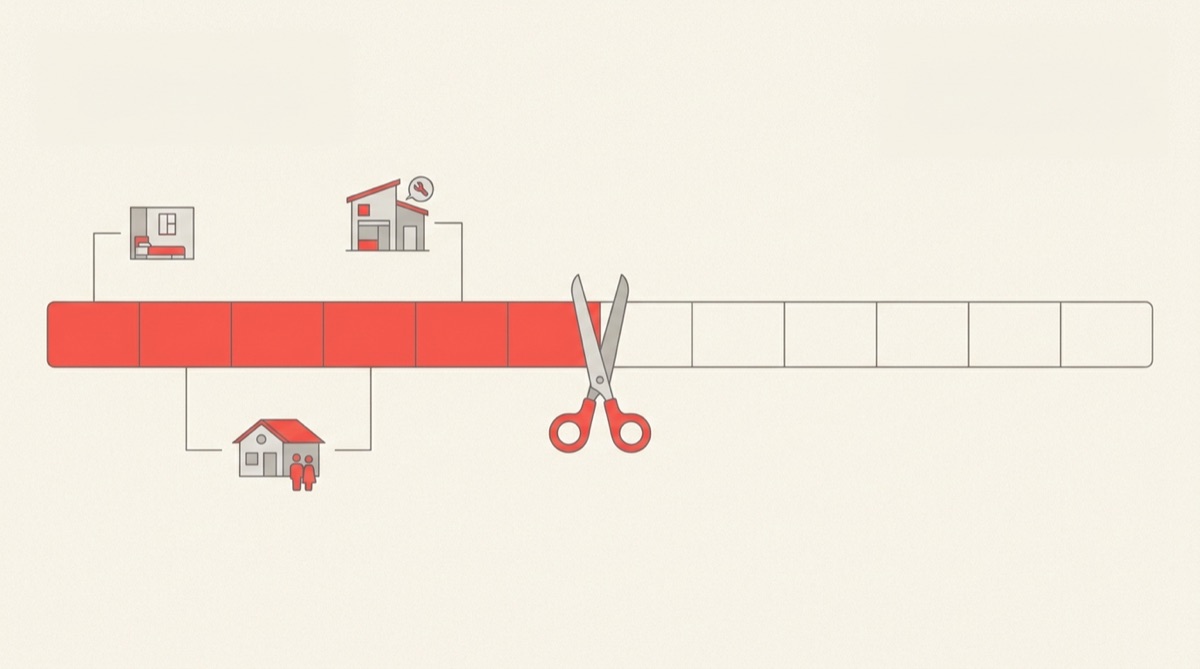 12 MONTHS6 MONTHS
Key takeaways
- Korea's listings quote one year, but the Housing Lease Protection Act lets a tenant enforce a shorter agreed term. The wall in front of you is commercial, not legal.
- For 3–6 months there are five real options, and choosing between them is mostly a decision about how much deposit you can wire before you land.
- The less deposit you put down, the less legal protection you hold. A gosiwon room and a serviced residence are usually not leases at all.
- Your protection chain is: written lease → take possession → report your address → get a 확정일자 stamp. Skip the address step and the rest of the chain does nothing.
- Arriving without an alien registration card means you have no address to register, and therefore no protection. Keep the deposit near zero until the card is in your hand.
Almost every room you will see advertised in Korea quotes 1년 (il-nyeon, one year). Ask for six months and a number of agents will simply stop replying. That silence is not a legal problem — it is a commercial one. Once you can tell which product each option actually is, and which of them are leases at all, a three-to-six-month stay becomes an ordinary request rather than a favour you are asking for.
Why the market says twelve months
A Korean landlord's income from a small rental is the monthly rent plus the use of your deposit, and their main cost is turnover: cleaning, vacancy, and a broker's fee each time the room changes hands. A six-month tenant doubles that cost per year. The agent's incentive points the same way, because the commission on a short lease is smaller for the same amount of work. Neither party is objecting to you. They are objecting to the maths.
This is the single most common friction point we see. Of 801 web-form inquiries we received between July 2025 and August 2026, 257 — about 32% — asked for a stay of one to six months. The median monthly rent those people were budgeting was ₩600,000 and the median deposit ₩1,500,000. Our inquiry base skews heavily toward Japanese nationals, so read the composition as indicative rather than as a national figure, but the direction is unambiguous: a third of arrivals want something the market's default product does not offer.5
Your five real options
The same building can appear in more than one row. What changes is the contract, not the room.
| Option | Realistic minimum | Deposit | Lease protection | Best for |
|---|---|---|---|---|
| 고시원 (gosiwon, single-room boarding house) | 1 month, rolling | Usually none | Normally contracted as facility use rather than a lease — assume none | Landing with no address and no ARC yet |
| 셰어하우스 / 코리빙 (share house, co-living) | 1–3 months | ₩300,000–1,000,000 | Operator contract; varies — read the document, not the website | The first months while you learn the city |
| 단기 월세 (dan-gi wolse, short-term monthly rent) | 3–6 months | ₩1,000,000–3,000,000 | Yes, when it is a written residential lease | The default answer for a 3–6 month stay |
| 전대 / 계약 승계 (jeondae, sublet or lease takeover) | Whatever remains on the original lease | Whatever the outgoing tenant paid | Only with the landlord's written consent | Cheap, when the paperwork is clean |
| 서비스드 레지던스 (serviced residence) | 30 days | None | No — this is lodging, not tenancy | Company-paid stays and your first two weeks |
Read the top and bottom rows together. A gosiwon and a serviced residence sit at opposite ends of the price range and share a legal character: you are buying accommodation, not tenancy. Everything between them is where the real trade-off lives.
Figures as of 2026-08 · verify the live listing5
| 고시원, shared bathroom | ₩350,000–550,000 / month | Deposit usually ₩0. Rice and kimchi in the shared kitchen is a standard amenity, not a joke. |
|---|---|---|
| 고시원, en-suite with a window | ₩500,000–750,000 / month | The window is what you are paying for. Ask to see the actual room, not the model room. |
| Share house / co-living, private room | ₩450,000–800,000 / month | Deposit ₩300,000–1,000,000. Utilities are usually bundled into the monthly figure. |
| 원룸 on a 3–6 month lease | ₩650,000–1,100,000 / month | Deposit ₩1,000,000–3,000,000. Expect this to sit above the twelve-month price for the identical room. |
| 관리비 (gwanribi, maintenance fee), on top of rent | ₩50,000–150,000 / month | Ask what it includes before comparing two rooms — it is where a cheap listing stops being cheap. |
| Serviced residence, monthly rate | ₩1,800,000–3,500,000 / month | No deposit, furnished, utilities and cleaning included. Usually only defensible when someone else is paying. |
Ranges observed in HeartStay concierge inquiries across the Sinchon–Ewha, Hongdae and Hoegi belts. This is our own case data, not a market survey; our inquiry base skews Japanese, and prices outside Seoul run lower.
What you give up as the deposit falls
A residential lease gives you two things a room contract does not. 대항력 (daehangnyeok) is the right to hold your lease against a new owner if the building is sold. 우선변제권 (useonbyeonjegwon) is priority in recovering your deposit from the proceeds if the property is auctioned. Neither is automatic. You acquire the first by taking possession of the property and registering your address there; you acquire the second by having a 확정일자 (hwakjeongilja, fixed-date stamp) added to your contract.1
As a registered foreign resident you do not file a 전입신고 at the district office the way a Korean national does. Your alien registration and your report of a change of residence to immigration stand in for 주민등록 and 전입신고 — the Immigration Act states this directly — and that report is due within 15 days of moving in. This one filing is what switches your lease protection on, so treat it as part of the move itself rather than as paperwork for later.23
How to secure a 3–6 month room
- 01
Fix the two dates before anything else
Your move-in date and your last night. Short-term stays are priced per calendar month, so a tenancy ending on the 8th is usually billed as a full month. The end date also decides whether you are negotiating a lease or booking accommodation — under roughly two months, you are booking.
- 02
Set your deposit ceiling before you start looking
This one number sorts the five options for you. Our inquiry median is ₩1,500,000. If you cannot move that before arrival, the gosiwon, share house and serviced residence rows are your market, and short-term leases and sublets are not — which is useful to know on day one rather than after three weeks of searching.
- 03
Shortlist two categories, not five
Running all five in parallel produces noise and slow replies. Pick the deposit band you can actually meet and work that band properly.
- 04
Ask four questions in your first message
단기 가능한가요? (Do you accept short-term?) · 최소 계약 기간은 얼마인가요? (What is the minimum term?) · 보증금은 얼마인가요? (What is the deposit?) · 관리비에 무엇이 포함되나요? (What does the maintenance fee cover?) An agent who answers all four in one reply is worth your time; one who answers none is telling you something.
- 05
Settle the brokerage fee in writing before you view
On sub-one-year deals agents commonly propose a flat fee rather than the usual percentage. Whatever the number is, get it in a message before you see anything — it is far easier to negotiate before you have fallen for a room than after.
- 06
Verify the property and the person signing
Pull the 등기부등본 (deungibudeungbon, property register) and check that the owner's name on it matches the ID of the person on the other side of the table, and that the bank account receiving your deposit is in that same name. For a six-month stay the downside is bounded, but the check costs almost nothing.
- 07
Sign in writing, even for three months
Use the 표준임대차계약서 (standard lease form) and write the end date, the deposit return date and who pays the brokerage fee into the 특약 (teugyak, special terms) section. A three-month verbal agreement is the most reliable way we know of to lose a deposit.
- 08
Register your address in your first week
Report your residence to immigration and take the contract for a 확정일자 stamp. Do it in the first week — fifteen days is shorter than it sounds when you are also opening a bank account and starting classes or work.
What to have ready before you sign
- Passport The name on the lease must match it exactly, middle names included. A mismatch will cause problems at the deposit-return stage, not at signing.
- Alien registration card, or the application receipt Optional If you do not have one yet, say so early. It changes which options are open to you, not whether you are welcome.
- Proof of enrolment or employment Optional Universities and employers issue these in English, and many landlords accept one in place of income documents for a short tenancy.
- A Korean phone number Contracts, building management and every delivery service assume you have one. A prepaid eSIM on arrival is enough to sign with.
- A working way to move the deposit Either a Korean account or an international transfer your bank will actually clear on the agreed day. Deposits are wired, not paid by card.
- An emergency contact in Korea Optional Frequently requested on short-term contracts. A school office or an employer's HR contact is normally accepted.
- The lease itself, in Korean An English translation is useful to you; the Korean text is the one that binds. Do not sign a version nobody has read to you.
From first message to protected tenancy
- Before you fly Fix your dates, set the deposit ceiling, shortlist one or two categories Everything downstream gets easier once these three are decided.
- First contact Ask the four short-term questions and get the brokerage fee in writing
- Viewing See the room, or have someone view it on video for you Never sign from listing photographs alone — they are frequently of a different unit in the same building.
- Signing Standard lease form, special terms filled in, deposit wired to the owner's own account The account holder's name should match the property register.
- Move-in day Take possession and photograph the condition of the room Date-stamped photos of every existing mark are what make the deposit conversation short.
- Within 15 days of moving in Report your change of residence to immigration and get the 확정일자 stamp This is the step that turns a signed contract into an enforceable tenancy.
- One month before you leave Give notice in writing and agree the deposit return date Settle the final 관리비 and utility readings before you hand back the keys.
One term is roughly four to five months — precisely the length the private market serves worst. Take the dormitory for your first term if it is offered, even if it is not where you would choose to live. It gives you a registrable address, a fixed cost and a base from which to view rooms in person, which is worth more than the neighbourhood you gave up. Move off campus for the second term, when you can see rooms yourself and negotiate face to face.
You will most likely arrive before you have a job, and the job will decide your commute. Do not sign a twelve-month lease in your first week to save on rent. One or two months in a share house costs more per night and far less than breaking a lease in a district you turned out not to need.
If your employer is paying, a serviced residence is the fastest route and issues a 세금계산서 (tax invoice) your finance team will need. Before defaulting to it, ask whether the company will instead advance the deposit on a normal short lease — over four to six months the monthly saving is usually larger than the administrative friction, and the room is a home rather than a hotel.
See short-term-friendly rooms around Sinchon, Ewha and Hongdae
The three stations our short-stay inquiries name most often.
Can I sign for six months and extend later?
Yes, and that is the safer order. Extending a short lease is a conversation; shortening a long one is a negotiation you will usually lose. Agree any extension in writing before the original term expires, and confirm whether the rent changes.
Is a gosiwon address good enough for alien registration?
Usually yes, provided the building has a proper registered address and the operator will give you a document showing that you live there. Ask before you pay — some operators decline, and that turns a cheap room into an expensive problem when you reach the immigration office.
The agent says short-term is impossible in this building. Is that true?
Sometimes it genuinely is: some owners borrow against a fixed twelve-month income and some buildings are managed under blanket rules. But 'impossible' more often means 'not worth my commission'. Settle the fee question first and ask again, or move to an agent who works the short-term segment.
Should I prepay several months of rent for a discount?
Only against a written lease, with an owner you have confirmed on the property register, and only if the discount is real. Prepaid rent does not carry the protection a registered deposit does — if the building changes hands or is auctioned, you are an ordinary creditor for the months you have already paid.
What happens to my deposit when I leave on time?
It is returned when you hand back the room, normally on the same day, less unpaid utilities and any damage beyond ordinary wear. Put the return date into the special terms and settle the final 관리비 and utility readings before you go — an unsettled maintenance bill is the single most common reason a refund is delayed.