Housing literacy
Ground floor, semi-basement, rooftop: what to avoid in Korea and why
Banjiha, oktapbang, first floor and top floor are not just cheaper rooms — they carry different legal status, different flood and mould exposure, and different paperwork. How to read the floor label, what to check on site, and what to put in the contract.
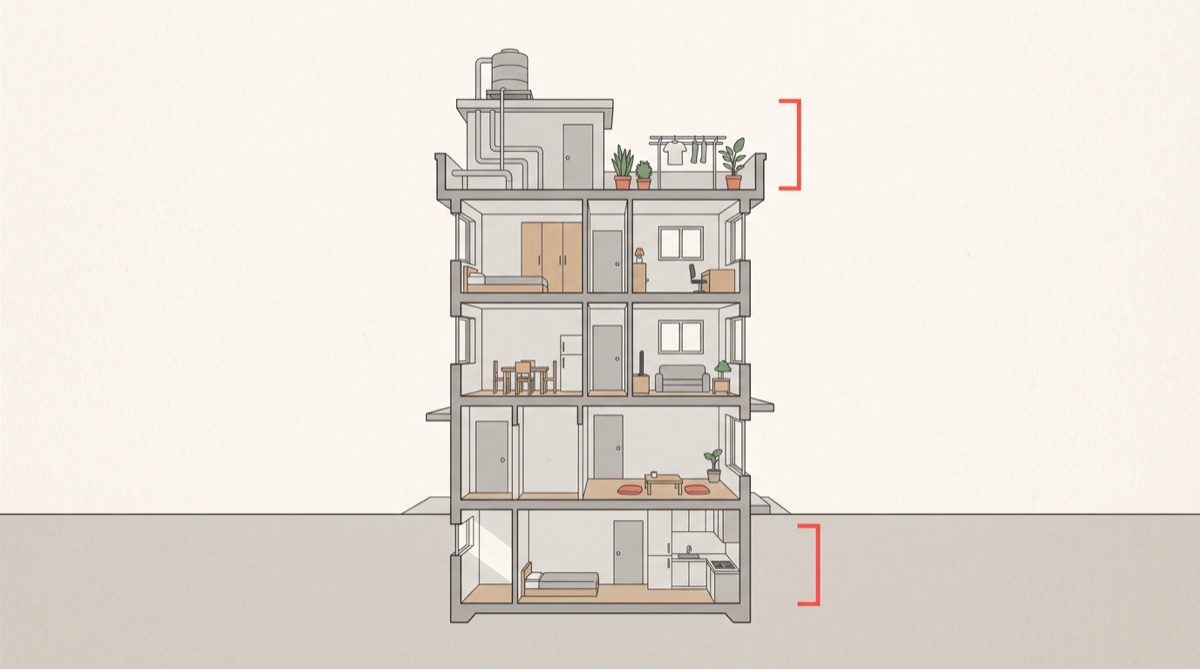 BELOWABOVE
Key takeaways
- The floor label in a Korean listing is a risk grade, not a discount. 반지하 (banjiha) and 옥탑방 (oktapbang) are cheaper because of specific, checkable defects — not because the market is being generous.
- The single most dangerous defect is water: flooding for semi-basements, roof leaks and heat for rooftop rooms. Both leave physical traces you can find in a ten-minute inspection.
- The most expensive defect is legal: many rooftop rooms are unauthorised extensions. Pull the 건축물대장 (building register) before you sign — it is free and it either shows the violation mark or it doesn't.
- Renting one is not illegal for you. Restrictions on semi-basements apply to new building permits, not to your tenancy. But an unregistered unit can break your address registration and your deposit protection.
- Whatever floor you take: take actual occupancy, register your address, and get 확정일자 (date stamp) on the contract. That trio is what makes your deposit claim enforceable.
If you are searching for a room in Seoul on a 3–24 month stay, you will notice the same pattern within an hour: two rooms in the same neighbourhood, similar size, similar photos, and a rent gap large enough to feel like a mistake. It is not a mistake. In almost every case the cheaper room is below ground, on the ground floor, or on the roof. This guide is about what that gap is actually paying for, and which parts of it you can inspect away.
The five floor labels you will see in listings
Read the label before the price. The last two rows are different things and are often translated into English identically.12
| Listing term | Romanization | What it actually is | What you are actually accepting |
|---|---|---|---|
| 지하 | jiha | Fully below ground level; no window opening onto the street | No natural light, persistent damp, highest flood exposure; frequently not registered as a dwelling |
| 반지하 | banjiha | Floor sits below ground, ceiling and windows sit above it — windows open at sidewalk height | Flooding during the summer rains, condensation and mould, and windows that a passer-by can reach |
| 1층 | il-cheung | Ground floor, at or slightly above street level | Break-in and privacy exposure, street noise, insects; low-lying units still flood |
| 옥탑방 | oktapbang | A room built on the roof slab, usually reached by an outdoor staircase | Often an unauthorised extension; extreme summer heat and winter cold, weak water pressure, leaks |
| 최상층 | choesangcheung | The top floor inside the building — not a rooftop room | Heat and roof-slab leaks, but a normal, registered unit. Commonly confused with 옥탑방 in translated listings |
Semi-basement (반지하): water is the risk that matters
Semi-basement housing is not a fringe category in Korea. The 2020 Population and Housing Census counted roughly 327,000 households living in basement or semi-basement homes nationwide, with around 200,000 of those in Seoul — concentrated in exactly the older low-rise districts where cheap rooms near universities are found.5
The failure mode is seasonal and abrupt. Korea's main rainy season runs roughly June through September, and a semi-basement fails in two ways at once: surface water enters through the street-level window well, and the building's drainage backs up through the floor drain and toilet. Water rises faster than the door can be opened against it. After Seoul's record rainfall in August 2022 — during which a family died in a flooded semi-basement in Gwanak-gu, as widely reported in the press — national and city authorities moved to restrict new semi-basement dwellings and to subsidise flood-prevention hardware in existing ones.67
Rooftop rooms (옥탑방): the risk is on paper, not just on the roof
A rooftop room is often the best-lit, most private cheap room you will see all week. The problem is that a large share of them were added to the roof slab after the building was completed, without a permit. Korean building administration records this: the 건축물대장 (geonchungmul-daejang, building register) carries a 위반건축물 (wiban-geonchungmul, violation building) mark in its header when a structure has been built or extended without authorisation.2
The physical side is simpler and easier to inspect. Rooftop rooms sit on top of the building's waterproofing layer, so you are living directly under the sun and directly on the drainage. Look for cracks or peeling in the grey or green urethane coating on the roof deck, check that roof drains are not blocked with leaves and cigarette ends, and look at the ceiling corners inside for brown rings. Ask what the room costs to cool in August and to heat in January — a single-glazed rooftop room can erase its own rent discount through utilities alone.
Ground floor and top floor: smaller risks, still real
Ground-floor units trade money for exposure. The relevant checks are security and privacy rather than water: bars or a security grille on every opening window, a lock on the building's entrance rather than only on your door, whether the window looks onto a busy sidewalk or a blind alley, and whether parcels are left on the ground outside. In our concierge cases, 14% of free-text inquiries raised safety as an explicit concern without being asked — the highest unprompted theme after price — and ground-floor and semi-basement rooms are where that concern is concrete rather than abstract.
The top floor of a building is a normal registered unit and should not be lumped in with rooftop rooms. Its weaknesses are heat in summer and leaks from the roof slab above. If the ceiling shows any staining, ask when the roof was last waterproofed. Otherwise a top floor is usually the quietest, brightest option in an old low-rise, and it is frequently underpriced simply because there is no lift.
Before you sign: pull these documents
The paperwork that decides whether the room is a bargain or a trap
- 건축물대장 (building register) Free to view and issue online through Government24. Check three things: that your unit appears at all, that its listed use is residential, and whether the header carries the 위반건축물 violation mark. This is the single document that separates a legitimate rooftop room from an unauthorised one.
- 등기부등본 (property registration certificate) Issued through the Supreme Court's Internet Registry Office for a small fee. The owner named here must be the person signing your contract, or an agent with written authority from them. Also read the encumbrance section for mortgages ranking ahead of your deposit.
- Dated photographs of the defect zones Bottom 60 cm of every wall, window frames and sills, ceiling corners, and under the sink. Take them at viewing and again on move-in day. This is what settles a mould or water dispute at move-out.
- 특약사항 (special clauses) written into the contract Flooding history and remedy; for a rooftop room, what happens if a correction or demolition order is issued; and confirmation that repair of building defects such as damp, mould and leaks is the landlord's responsibility. Korean law places the duty to keep the property in usable condition on the landlord, but writing it down removes the argument.
- 확정일자 (date stamp) on the signed contract Obtained at the local community service centre or online through the Internet Registry Office, using your alien registration card. Costs very little and establishes the priority of your deposit claim.
The 30-minute viewing routine for a low or high room
- 01
Stand outside and find the water line
For a semi-basement: measure by eye where the bottom of the window sits relative to the sidewalk, and look for a slot or bracket for a 물막이판 (water barrier board) at the entrance. Look at where the street slopes — a unit at the bottom of an incline collects everything above it. For a rooftop room: look up at the roof edge for staining, and check where the downpipes discharge.
- 02
Close the window and wait two minutes
Agents open windows before you arrive. Close everything, stop talking, and let the air settle. Mould smell returns quickly in a room that has it. Do the same with the bathroom door closed.
- 03
Run your hand along the bottom of every wall
Damp reads as cool and slightly soft through wallpaper. Press the corners behind where a bed would go, and check inside the built-in wardrobe — that is where condensation collects and where new wallpaper usually stops.
- 04
Open the taps and flush
Rooftop rooms sit at the end of the water supply: run the shower and the sink together and watch the pressure. Everywhere else, check that the floor drain drains rather than gurgling back, and ask whether there is a backflow prevention valve.
- 05
Test the room's own security, not the building's
Every window that opens should have a grille or a lock you can operate from inside. Check whether the window well can be reached from the street, whether the entrance is covered by a camera, and whether the outdoor stair to a rooftop room is lit at night. Visit once after dark if you can.
- 06
Ask the two questions that cannot be inspected
"Has this unit ever flooded or leaked?" and, for a rooftop room, "Is this room on the building register?" Ask both in front of the agent, and ask for the answers to be reflected in the contract's special clauses. You are not being difficult; you are converting a verbal answer into an enforceable one.
After you sign: the sequence that protects your deposit
Move-in administration, in the order that matters
- Contract day Re-issue the property registration certificate on the same day you sign A certificate pulled a week earlier does not show a mortgage registered yesterday. Sign only after reading the copy issued that morning, and pay the deposit to an account in the registered owner's name.
- Contract day Get 확정일자 on the contract At the community service centre or online. This fixes the date from which your deposit claim takes priority.
- Move-in day Take actual occupancy Protection against a future owner requires real occupancy plus a registered address — not just a signed contract. Move your belongings in and sleep there.
- Within 15 days of moving Report your change of residence as a registered foreign resident Under Korea's immigration rules a registered foreigner must report a change of residence within 15 days, at an immigration office or the local community service centre. For foreign residents this registration performs the role that resident registration performs for Korean nationals in lease protection — so a missed or failed filing is not only an immigration issue, it weakens your deposit position. If the address will not register because the unit is not on the building register, treat that as an emergency, not paperwork.
- First June after move-in Photograph the room before the rainy season Dated photos of dry walls and clean ceiling corners before the rains are the cheapest insurance you will ever buy against a move-out dispute over mould.
Figures as of 2026-08 · verify the live listing
| Monthly rent, median | ₩600,000 | Median across 801 HeartStay web-form inquiries, July 2025 – August 2026, mostly Seoul university districts. |
|---|---|---|
| Deposit, median | ₩1,500,000 | Low-deposit monthly rent is the normal structure for foreign residents on 3–24 month stays, not an exception. |
| Semi-basement or rooftop discount vs. an upper floor | Lower, but we do not publish a single figure | The gap moves with district, building age, and how recently the unit flooded. Any single number you see quoted for this is invented. Judge the discount against the specific defects you found on site, not against an average. |
| Cooling and heating on a rooftop room | Higher than an equivalent mid-floor unit; amount varies by insulation and glazing | Ask the outgoing tenant or the landlord for an actual August and January bill. Refusal is information. |
Figures are from HeartStay's own inquiry records, not a government statistic. The sample skews heavily toward Japanese nationals and toward the Sinchon, Hongdae and Ewha area, so treat it as directional for that profile rather than as a national benchmark.
Your exposure is asymmetric: you will probably be in Korea for exactly one rainy season, and you have the least ability to absorb a mid-stay move. A rooftop room in a violation building is the worst fit for you specifically — not because the risk is higher, but because you have no slack if it materialises. Keep the deposit at the low end, and prefer a registered mid-floor room over a larger unregistered one.
If the choice really is semi-basement or nothing, choose the semi-basement that is on a slope rather than at the bottom of one, that already has a water barrier fitting at the door, and whose window sits clearly above the sidewalk. Then write the flooding clause into the contract and keep your passport, laptop and documents above waist height. Those three decisions cost nothing and remove most of the realistic downside.
See rooms by floor level around Sinchon, Ewha and Hongdae
Filter to above-ground floors first, then decide consciously whether a discount below ground or on the roof is worth it. Our concierge reads the building register for any unit before you view it.
The landlord says the rooftop room is 'registered'. How do I verify that without reading Korean?
Ask for the 건축물대장 for the building, or issue it yourself through Government24. Two things matter and both are visually findable: the violation-building mark appears in the header area of the first page, and the floor list further down should show a room on the roof level. If the roof level shows nothing but your room physically exists, the room is unauthorised regardless of what you are told. Send us the document and we will read it for you before you sign.
I already signed, and now I have found the violation mark. What do I do?
Do not panic and do not stop paying rent — your lease is still a lease. Confirm in writing with the landlord what happens if a correction order is issued, get your address registration completed and 확정일자 stamped immediately so your deposit claim has priority, and keep the deposit from growing at renewal. If you have not yet paid the balance, this is the moment to renegotiate the deposit downward or withdraw.
Can I ask the landlord to install a water barrier at the entrance?
Yes, and it is a reasonable ask rather than an unusual one — Seoul and several districts have run support programmes for flood-prevention hardware in semi-basement homes, so the cost to the owner may be partly covered. Ask the landlord to check with the district office. If they agree, put the installation and its deadline in the contract's special clauses rather than leaving it as a promise.
My deposit is only ₩1,500,000. Is 확정일자 still worth the trip?
Yes. The fee is negligible, it takes minutes, and small deposits are the ones most often written off rather than fought over — which is precisely why having the priority date on paper changes the conversation. It also creates a dated official record that your contract existed in that form, which is useful in any dispute, not only in a deposit-recovery one.