Housing literacy
No, you do not need jeonse: what foreigners actually pay to rent in Korea
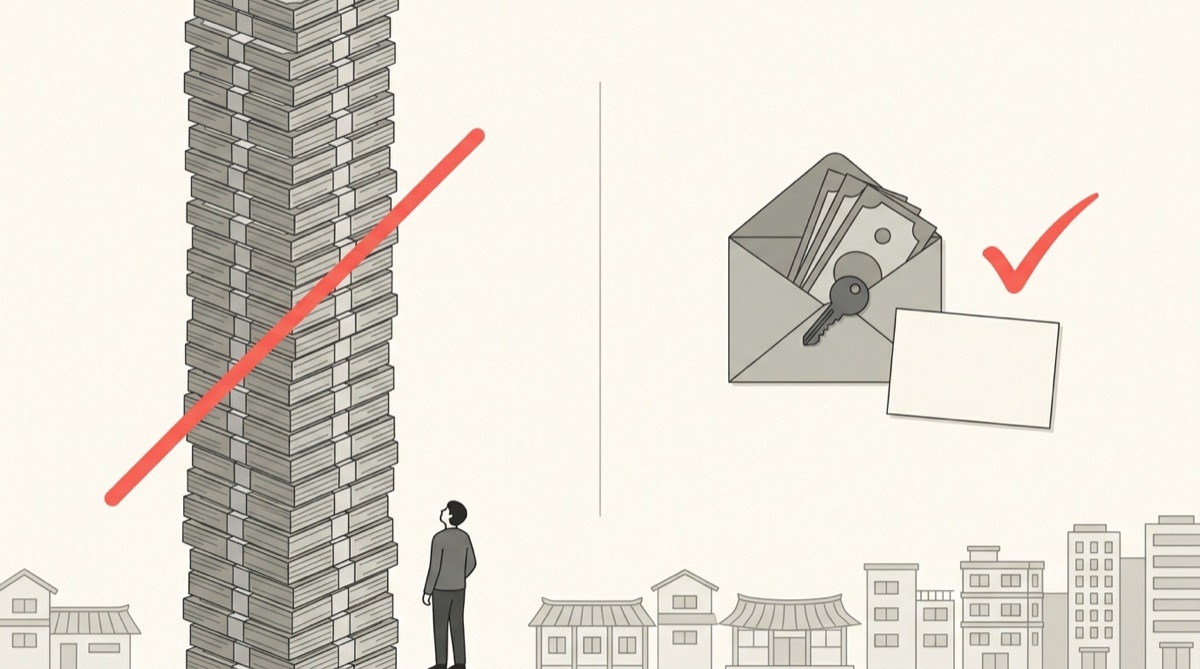
English guides keep repeating that Korean tenants hand over 50–80% of a property value as jeonse. For a 3–24 month foreign resident that is simply the wrong product — here is what the government data and our own inquiries actually show.
 JEONSEMONTHLY RENTdeposit ₩1,500,000
₩600,000 / month
JEONSEMONTHLY RENTdeposit ₩1,500,000
₩600,000 / monthKey takeaways
- Jeonse (전세) is a large lump-sum deposit with little or no monthly rent. It is not the normal product for a 3–24 month foreign stay.
- Monthly rent now dominates: press tabulations of government lease-transaction data put the monthly-rent share at 62.7% of deals in 2025 (Jan–Nov).
- Across 801 inquiries to our concierge, the median deposit was ₩1.5M and median monthly rent ₩600,000 — not "50% of the property value".
- What you will actually be quoted: a deposit measured in millions of won, plus monthly rent, plus 관리비 (building maintenance fee).
- If someone pushes a jeonse-style lump sum before you have seen the unit and checked the register, treat it as a red flag.
Search "renting in Korea" in English and you will meet the same sentence over and over: Korean tenants hand the landlord 50–80% of a property's value and then live rent-free. That description of jeonse is not invented — the system is real — but presenting it as what you will do is wrong, and it sets newcomers up to be scared or scammed.
If you are coming for a language programme, an exchange semester, a working holiday, a teaching contract or a two-year assignment, you are almost certainly renting 월세 (wolse): a comparatively small deposit plus monthly rent. This guide shows what the numbers actually look like, and where each number comes from.
What the transaction data says
Korea is not "the land of jeonse" anymore. Every lease transaction is reported to the government and published through the national transaction and statistics systems, and the direction those systems show is consistent: monthly-rent contracts have been gaining share on jeonse for years, and Korean press summarising that data reported monthly rent passing 60% of all lease deals in 2025. We have not re-derived that series ourselves, so treat the exact percentage as press-reported rather than as our claim — the direction, not the decimal, is what matters for your decision.534
That is the market as a whole, including Korean families with decades of savings. Narrow it to foreigners staying under two years, with no Korean credit history and no local guarantor, and the jeonse share drops close to irrelevant. The capital requirement alone rules it out.
What our own inquiries look like
We can also answer this from our own book of work rather than theory. Across 801 housing inquiries submitted to our concierge between July 2025 and August 2026, the median stated budget was a ₩1.5M deposit and ₩600,000 monthly rent. Note the composition honestly: the large majority of those inquiries came from Japanese nationals, and most were students, language-programme participants or working-holiday arrivals. It is a real sample of mid-term foreign renters, not a national census.7
Figures as of 2026-08 · verify the live listing7
| Deposit (보증금) — median | ₩1,500,000 | Refundable at move-out |
|---|---|---|
| Monthly rent (월세) — median | ₩600,000 | Before 관리비 |
| Maintenance fee (관리비) | ask per listing | Not captured as a field in our inquiry records — always ask what it covers |
| Utilities beyond 관리비 | budget a buffer | Heating in winter, aircon in summer |
| Typical stay | 12 months | 35% of our inquiries |
Medians from our own inquiry records, not a market-wide index. Seoul central districts and new-build towers sit well above these figures. Always price the specific unit.
Nearly a third of the inquiries we handle are working-holiday arrivals, and about a third of all stays are under six months. If that is you, the deposit — not the rent — is usually the number that decides where you can live, because it is frozen until you move out.
Why jeonse is not your product
| Jeonse (전세) | Wolse (월세) — what you will use | |
|---|---|---|
| Upfront cash | A very large lump sum | A deposit in the millions of won |
| Monthly payment | Little or none | Rent + 관리비 every month |
| Who it suits | Long-term residents with capital | Mid-term residents, students, workers |
| Realistic for a 12-month stay? | No | Yes — this is the standard |
| Main risk to manage | Recovering a very large deposit | Deposit return, fees, contract terms |
Protections that apply once you do sign
Korea's Housing Lease Protection Act (주택임대차보호법) is the statute that governs residential leases — deposit-related protections, lease term and renewal. An English reference text is published on the national law information centre, and the government also runs a plain-language explainer service. Two practical habits follow from it. First, register your address at the local office after moving in. Second, get 확정일자 on your contract — a dated official stamp recording that this contract existed on that date, which is what fixes your priority against other claims on the property. Do both in your first days, not "later": together they are what put you in a defensible position if the deposit is ever disputed. Whether and how each protection applies to your specific contract is worth confirming for your own case.12
Before any money moves: verify the property
The single habit that separates a safe contract from a bad one is checking who actually owns the unit before you transfer anything. Korea publishes property registers online, so this is something you can do yourself in minutes rather than something you have to take on trust.6
Verification checklist
- Pull the property register (등기부등본) for the exact unit The Supreme Court internet registry office (iros.go.kr) issues them online for a small fee. Get it for the specific unit number, not the building in general.
- Match the owner name on the register to the person signing If the signer is an agent or family member, ask for written authority to lease. A mismatch you cannot explain is a stop sign.
- Check what is already registered against the property Existing mortgages or claims recorded on the register affect how safe your deposit is. If you cannot read it, have someone go through it with you before signing.
- Confirm the licensed agent Optional Ask to see the brokerage registration. Legitimate agents expect this question.
- Get every number in writing Deposit, monthly rent, 관리비, what utilities are included, move-in and move-out dates.
Build your budget in five steps
- 01
Separate deposit cash from monthly cash
The deposit is frozen until move-out. Decide the maximum you can lock away without draining your buffer.
- 02
Price the total monthly, not the rent
Rent + 관리비 + a utility buffer. Two rooms with identical rent can differ meaningfully once fees are included.
- 03
Fix your commute pin first
Campus gate or office door. Rent is bought in minutes of commute — set the location before you compare prices.
- 04
Ask what the deposit does to the rent
A higher deposit often lowers monthly rent, and the reverse. Ask for both versions in writing and compare them over your full stay.
- 05
Verify before any money moves
See the unit, confirm who legally may lease it, and get the amounts written down. Then register your address and get 확정일자.
See what these numbers buy in each area
Filter by home type and compare deposit and monthly rent on live listings.
Could I do jeonse if I actually had the money?
The product itself is not advertised as nationality-restricted, but the capital required is very large and, in the cases we handle, mid-term foreign renters are rarely offered it in practice. For a stay under two years, locking that much cash away is rarely a sensible use of your money regardless.
Is a lower deposit always better?
Not automatically. A lower deposit usually means higher monthly rent. Multiply both over the months you will actually stay, then compare — a bigger deposit can be cheaper overall if you can afford to lock the cash.
Is the deposit really refunded in full?
It is returned at the end of the lease. Landlords commonly deduct things like unpaid rent or damage beyond normal wear, so agree in writing at signing what counts as normal wear. The statutory framework is the Housing Lease Protection Act (source 1); the habits that make your claim defensible are photographing the unit at move-in, keeping the contract, registering your address and getting 확정일자.
The listing says "no deposit". Is that a scam?
Not necessarily — some short-term and sharehouse products genuinely run low or zero deposit, which is why they suit stays under six months. Judge it by whether the operator, the unit and the contract are verifiable, not by the deposit figure alone.
Do I need a Korean guarantor?
It depends on the landlord and the product. Many foreigner-friendly mid-term rooms reduce this friction. Ask in your first inquiry so it does not surface at signing.