Housing literacy
Safety Checklist for Solo Women Renting in Korea
Security in a Korean rental is decided at the shared front door, in the public property records, and on the walk home at 10pm — not by how the room feels at noon. A three-stage checklist you can run before, during, and after a viewing.
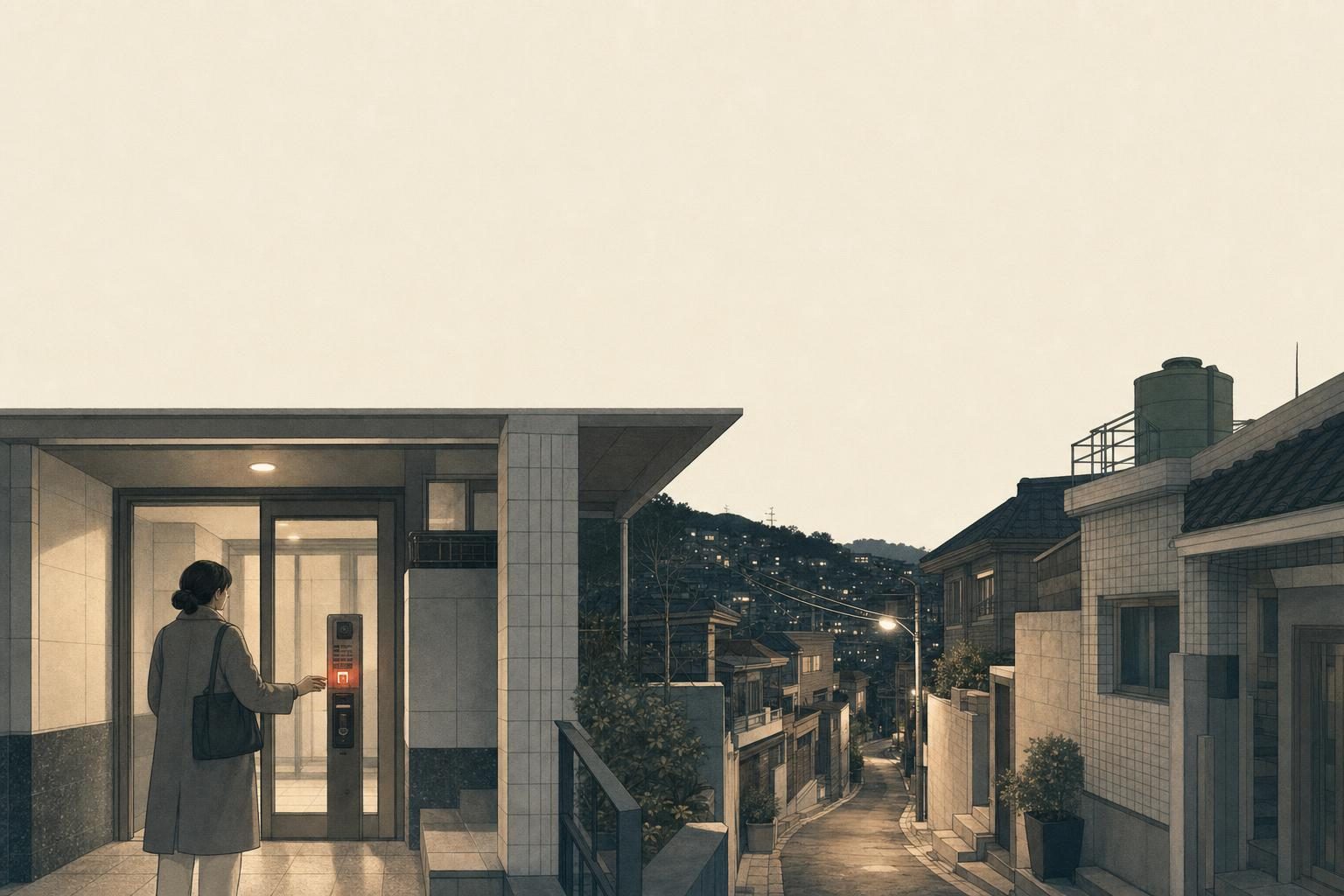 DAY10 PM
Key takeaways
- Judge the shared entrance before you judge the room. A front door that actually latches, a camera that actually records, and a stairwell you can see into decide more than anything inside the unit.
- Two of your three checks happen before you leave your desk: the 건축물대장 (geonchungmul daejang, building ledger) tells you what the building legally is, and the 등기사항전부증명서 (property registry extract) tells you who is really renting to you.
- Visit twice — once in daylight, once after 10pm. The walk from the station is the part of the lease you cannot renegotiate later.
- Budget roughly ₩150,000–₩300,000 for lock and window hardware in your first week. That is under half of one month's median rent among our concierge inquiries (₩600,000).
- File your 체류지 변경신고 (change-of-residence report) within 14 days of moving. It is an Immigration Act obligation, not an optional formality.
Across 801 web inquiries we received between July 2025 and August 2026, 14% of people who wrote a free-text message raised safety unprompted — auto-locking entrances, ground-floor windows, the walk from the station. Most of them were women arriving alone for three to twenty-four months. The sample skews heavily Japanese, so treat the proportion as directional rather than national. What is not directional is the pattern in what they asked about: almost every question was about the building, not the room.10
Stage 1 — Before you book a viewing
Three checks cost nothing and take about twenty minutes. Do them from the listing address alone, before you spend an afternoon travelling to a room you will reject. The building ledger and the property registry are both public: anyone can pull them with an address, and no landlord permission is involved.345
- 01
Pull the 건축물대장 (building ledger) by address
Available through 정부24 or 세움터. Two fields matter. First, the registered use (용도): a room advertised as an 'officetel' or 'studio' may be registered as 근린생활시설 (neighbourhood facility, i.e. commercial), which affects your rights and your insurance. Second, a 위반건축물 (illegal structure) marking, which appears when floors, rooftop rooms or partitions were added without permit — often the same rooms with no proper fire exit.
- 02
Pull the 등기사항전부증명서 (property registry extract)
From the Supreme Court's 인터넷등기소, for a small fee. The owner named here must be the person who signs your lease. If a different name appears, stop and get the relationship documented in writing before you view — this is the single most common route into a rental fraud.
- 03
Walk the route on street view, then check what is open at night
Trace the path from the nearest station or bus stop to the building entrance. Count the segments with no streetlight, note whether the building's front door is visible from a main road, and look for a 24-hour convenience store on the route — in practice it functions as a lit, staffed refuge. Also find the nearest 지구대 or 파출소 (local police post).
- 04
Check the agent, not just the listing
A licensed agency must display its 중개사무소 등록증 (agency registration) and 공제증서 (liability insurance certificate) in the office. Ask for both by photo before the viewing. The registration number on those documents must match the one printed on your eventual contract, and your district office (구청) can confirm the agency is registered.
Stage 2 — At the viewing, work from the outside in
Agents show you the room. Show yourself the entrance, the stairwell and the windows first — you can always look at the wallpaper afterwards. Each check below takes under a minute and none of them require you to be confrontational; they are things you can do while the agent is talking.
Physical security checks, in the order you encounter them
| What to check | How, in thirty seconds | Treat as a hard no |
|---|---|---|
| Shared entrance auto-lock (공동현관 오토록) | Let the door swing shut behind you, then try to pull it open without entering a code. | It does not latch, is propped open for deliveries, or the code is written on or near the keypad. |
| Entrance and corridor cameras | Ask the agent where the recorder is kept and when footage was last retrieved. | Nobody knows where the recorder is, or the housing has no cable running to it. |
| Sightlines from the door to the street | Stand at the unit door and look back toward the entrance. Note whether lights are on a motion sensor and how long they stay on. | You cannot see who followed you in, and the stair lighting cuts out before you reach your door. |
| The unit door itself | Look for worn digits on the keypad, a door viewer, a secondary latch, and an old milk-delivery slot (우유투입구) low on the door. | Worn digits with no fingerprint option and a landlord who refuses a lock change or code reset. |
| Every window, opened | Open each one and look at what is within arm's reach outside: a shared corridor, a neighbouring rooftop, an air-conditioner unit, or an exterior gas pipe. | A window opens onto a shared corridor or accessible rooftop and has no working lock. |
| Ground-floor and semi-basement units (반지하) | Stand outside and see how much of the room is visible from the pavement. Check whether window bars (방범창) include a section that opens. | Bars welded shut across the only window, or a room where passers-by can see the bed. |
| Who else is on the floor | Ask directly how many units are occupied, by whom, and whether the building or floor is 여성전용 (women-only). | The agent will not answer, or answers differently on a second visit. |
Documents to have in hand before you sign
- 건축물대장 (building ledger) Confirms legal use and shows any 위반건축물 marking. Free to view by address; do not accept the agent's summary of it.
- 등기사항전부증명서 (property registry extract) Owner name must match the lease signatory. Also shows mortgages (근저당권) registered against the building.
- 중개사무소 등록증 and 공제증서 Agency registration and liability insurance. Photograph both; the registration number must match your contract.
- Owner's ID, checked against the registry If you are dealing with a family member or manager, ask for written authority from the registered owner.
- 특약사항 (special terms) written into the contract Put the lock change or code reset, the gas-pipe cover, any window locks, and who pays for each into the contract itself. A verbal promise at the viewing is not enforceable.
Stage 3 — Go back at 10pm
This is the step most people skip, and it is the one that changes decisions. Repeat the walk from the station in the dark, on a weeknight, at the hour you would actually come home. You are checking four things: whether the streetlights are continuous or interrupted, whether the last hundred metres are overlooked by anyone, whether the building's shared entrance is standing open, and how loud the ground floor is — a room above a bar that is quiet at 2pm is a different room at 1am. If the agent will not accompany you at night, go with a friend, or ask us to send someone; refusing a second visit is itself information about the listing.
Move-in week: the first 72 hours do most of the work
From handover to settled
- Day 0, at handover Reset or replace the door lock Either change the digital lock (agreed in the 특약) or have the landlord reset the code while you watch. Ask explicitly how many codes existed and whether any were issued to a cleaner, a previous tenant or a delivery service.
- Day 0 Remove your name from public surfaces Nothing with your full name on the door, mailbox or intercom. Use a surname or initials only.
- Day 1–3 Redirect deliveries away from your door Use a convenience-store pickup point, or in Seoul a 여성안심택배 locker — a free city-run parcel locker network intended for exactly this. Register the pickup under initials.
- Day 1–3 Fit window locks and test the curtains Every window should latch. Curtains or blinds should close with no gap — silhouette exposure at night is the most common complaint we hear from ground and second-floor tenants.
- Within 14 days of moving File your 체류지 변경신고 (change-of-residence report) Required under the Immigration Act after a change of residence. File through HiKorea, at an immigration office, or at your local district or community office. This is also the step that anchors your legal address to the lease.
- Week 1–2 Ask your 구청 about a safety home kit Several Seoul districts run an 안심홈세트 programme for single-person households — smart doorbell, door-open sensor, window locks, supplied free or heavily subsidised. Eligibility rules and whether registered foreign residents qualify vary by district, so ask your own 구청 rather than assuming.
- Week 2 Prepare for the call you hope not to make Save 112, 119, 1366 and 1345. Write your full address in Korean in your notes app and set it as a lock-screen widget if you can — under stress, reading a Korean address aloud is the part that fails.
Figures as of 2026-08 · verify the live listing10
| Digital door lock, replaced and installed | ₩80,000–₩250,000 | Fingerprint and push-pull models sit at the top of the range. Settle who pays before signing, not after. |
|---|---|---|
| Portable door lock (문틀 잠금장치) | ₩10,000–₩30,000 | For stays under roughly six months, or where the landlord will not permit a lock change. |
| Window auxiliary lock or stopper | ₩5,000–₩20,000 per window | Also limits how far a window opens while ventilating. |
| Privacy or anti-shatter window film | ₩10,000–₩30,000 per window | The cheapest fix for ground-floor and semi-basement exposure. |
| Door-open sensor or smart doorbell | ₩30,000–₩100,000 | Often free through a district 안심홈세트 programme — ask before buying. |
| Indoor camera | ₩30,000–₩80,000 | Point it at the entry door, not the room. |
| Sealing an unused milk slot (우유투입구) | ₩5,000–₩15,000 | Landlords rarely object; write it into the 특약 anyway. |
| Gas-pipe anti-climb cover (가스배관 방범커버) | Usually landlord or building cost | Ask the agent to raise it as a condition before you sign. |
Retail and installation prices observed by our concierge in Seoul as of August 2026, not official figures. They vary by district, model and building. Get one quote before agreeing who pays. For scale: the median monthly rent across our 801 inquiries was ₩600,000, so a full hardware pass costs well under half a month's rent.
Replacing the lock is usually not worth the negotiation. Insist instead that the code is reset in front of you on handover, and ask how many people held the old one. A portable door lock, two window stoppers and a pickup-point delivery address cover most of the remaining gap for under ₩50,000, and all three come with you to the next place.
Your door is one of many on a shared corridor, and the shared entrance gets propped open far more often. Ask three things: whether the floor is 여성전용 (women-only), whether the corridor camera records or only displays, and where the second exit is — walk to it and confirm the corridor is clear rather than used for storage. Keep documents and cash in a locked bag rather than in the room; in shared housing the realistic risk is a resident, not an outsider.
See rooms around Sinchon, Ewha and Hongdae
These are the three most-requested stations in our intake. Security varies street by street here more than it varies between districts — the alley matters more than the neighbourhood name.
Do I have to view a room alone with an agent I have never met?
No, and you do not need a reason to decline. Standard practice is to meet at the 중개사무소 (agency office) rather than at the unit, which also lets you photograph the registration and insurance certificates. Bring someone, share your live location, and send the agency's registration number to a friend before you go. An agent who objects to any of this has told you something useful.
Am I allowed to change the door lock myself?
The lock is part of the property, so you need the landlord's agreement — this is a negotiation, not a right. The usual arrangement: you pay, it goes into the 특약 (special terms), you keep the old lock and either restore it or hand the new one over at move-out. Many landlords accept when you offer to pay. If yours refuses outright, treat it as a signal about how the building is managed and weigh it against the rest of your checklist.
Is a women-only building automatically safer?
Not automatically. A 여성전용 building with a shared front door propped open all evening is less safe than a mixed building with an auto-lock that works and a camera that records. Women-only floors do reduce a specific risk — an unknown male resident on your corridor — so it is a real factor, just not one that overrides the entrance.
What do I do if the problem turns out to be a neighbour or the landlord?
Call 1366 — it is free, 24 hours, and handles harassment and threats, with multilingual support routed through 1577-1366. For anything happening now, 112. Separately, document it: dated photos, message screenshots, and a written record of what was said. If the person involved is your landlord or agent, do not negotiate alone over a doorstep conversation; put every exchange into text messages so a record exists, and ask a Korean-speaking third party — a university international office, a support centre, or us — to take the call with you.