Safety and security
Auto-lock, CCTV, delivery boxes: which security features are worth paying for
Listings advertise 오토락 and CCTV as if they were the same thing as safety. They are not. Here is what each feature actually stops, what it does not, and the order to spend your money in — starting with the one fix that costs nothing.
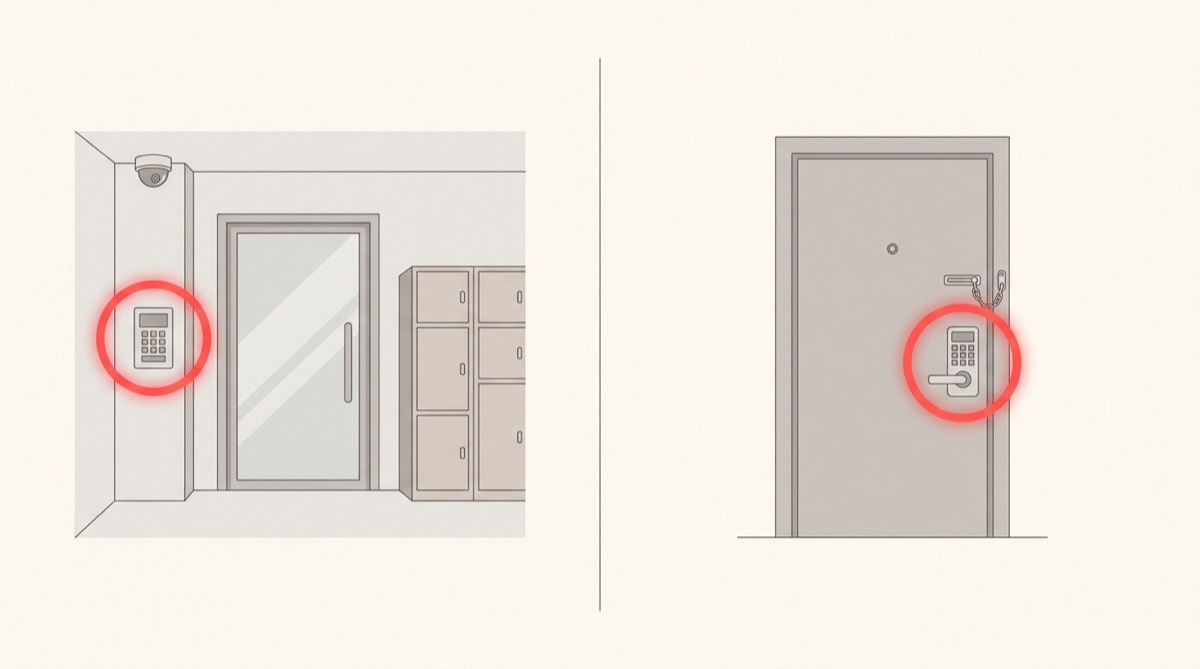 LOBBYYOUR DOOR
Key takeaways
- 오토락 (auto-lock) secures the shared lobby, not your unit. Treat it as convenience and casual deterrence, not protection.
- The highest-value action costs nothing: change the keypad code on your own door lock the day you get the keys. Assume the previous tenant still knows it.
- A fixed CCTV camera with no notice sign is a warning, not a feature — Korean privacy law requires operators to post one.
- Ask how many days footage is kept and who can retrieve it. In small buildings it is often overwritten quickly, and you cannot pull it yourself.
- Spend in this order: your unit's door lock, then reachable windows and floor level, then parcel handling, then the lobby auto-lock. Parcels are solvable for free.
Security is the feature foreign renters ask about most and evaluate least. In our own concierge intake — 801 web inquiries between 2025-07 and 2026-08 — 14% of people raised safety unprompted in the free-text field, and オートロック付き ("with auto-lock") is one of the most repeated phrases we receive. The sample skews heavily Japanese, so read it as a signal about that group rather than about every newcomer.7
The problem is that "오토락 있음" and "CCTV 완비" appear in listings as if they were a single product called safety. They are four separate things that protect against four different problems, and the one that gets the most attention protects the least. This guide separates them, then gives you a check you can run in about eight minutes at a viewing.
What each feature actually protects against
Four features, four different jobs12
| Feature | What it actually stops | What it does not stop | Who controls it |
|---|---|---|---|
| 오토락 (auto-lock, shared entrance) | Casual walk-ins, door-to-door sales, most flyer distributors | Anyone holding the code — couriers, former tenants, agents, contractors — and anyone who walks in behind you | The owner or building manager. Rotating the code is their decision, not yours |
| CCTV (영상정보처리기기) | Very little in real time. Its value is almost entirely after the fact | An intrusion in progress. In a small building nobody is watching the feed | The operator named on the legally required notice sign; requests normally go through them or the police |
| 무인택배함 (parcel locker) | Parcel theft, and your name, unit number and phone sitting on a label in a shared hallway | Anything to do with entry into the building | The building, or the city or district office for public lockers |
| 도어락 (your unit's digital lock) | The actual door between a stranger and your things | Nothing at all, if the code is still the one the last tenant used | You. This is the only item on the list you can fix today |
| 방범창 (window security bars) | Entry through ground-floor, semi-basement or pipe-reachable windows | Nothing on an upper floor with no access route — where it is often pure decoration | The landlord. This is a pre-signing negotiation, not a post-signing request |
Why auto-lock is the most over-weighted feature on the list
A shared-entrance code is only as private as the number of people who know it. In our concierge visits we routinely find the same building code in use for years, sometimes written on or beside the keypad, and known to every courier, food rider and letting agent who works the street. That is our observation across viewings, not a measured survey — but it is consistent enough that we no longer treat "오토락 있음" as a security fact.7
There is also a structural limit: an auto-lock protects a lobby, and almost nothing that happens to renters happens in the lobby. It is genuinely useful for reducing unwanted visitors at your door and for the cold-call and religious-solicitation problem that newcomers find wearing. Price it as that, not as a lock on your home.
Run the arithmetic before you pay a premium for it. The median monthly rent across our 801 inquiries was ₩600,000. If an auto-lock building costs even ₩50,000 more per month, a twelve-month stay pays a full extra month of median rent for the lobby door. The same money replaces your unit's lock, adds a portable lock and window locks, and leaves change.7
The eight-minute security check at a viewing
- 01
Watch how the shared entrance actually opens
Code, card, intercom, or permanently propped open with a brick? Then ask when the code was last changed. If the agent or manager says they do not know, the answer is that it has not been.
- 02
Look for the CCTV notice sign
Operators of fixed cameras are required under Korean privacy law to post a notice showing the purpose, the filming range, and who operates it with contact details. No sign is a meaningful signal — either nobody is accountable for the camera, or it is not really operating.
- 03
Check what the cameras are actually pointed at
Entrance and parcel area, or just the car park and the bins? A camera aimed at the street is not covering your door. Ask to see the monitor if there is a manager's office.
- 04
Ask two questions about footage
How many days is it kept, and who do you call at 2am? Small buildings often overwrite on a short cycle, and a camera whose recording is already gone by the time you notice a problem is not a security feature.
- 05
Walk the outside of the building
Look for the gas pipe, the air-conditioner bracket, the low wall, the stairwell window and any adjacent rooftop. Anything your window is reachable from is your real risk. This step finds more than the entire lobby inspection does.
- 06
Test every window, not just the big one
Does each one lock, and does the lock still bite? Note which windows are reachable from what you found in the previous step, and check whether those have 방범창 (window security bars).
- 07
Photograph the unit's door lock
Capture the model and the keypad. Worn or discoloured keys give away which digits are in the code — if four buttons are visibly worn, treat the current code as public. Ask whether the lock will be reset before handover, and get the answer in writing.
- 08
Look at where parcels land
Locker, manager's desk, or the hallway floor? If other tenants' boxes are sitting in the corridor during your viewing, that is the building's real parcel policy.
Get these in writing before you sign
- Permission to replace the door lock at your own cost With the agreement that you reinstall the original at move-out. Changing only the code needs no permission — replacing the hardware does.
- Who pays if the existing lock fails A lock that dies from normal wear is generally the landlord's problem, not a deduction from your deposit. Settle it before it happens.
- Confirmation that the door code will be reset before handover Ask for it even though you will change it again yourself. The refusal, if it comes, is informative.
- An emergency contact who is a person A name and mobile number with stated hours, not a daytime office line. Ask what happens at night and on holidays.
- Whether the building CCTV is operating, and who the operator is The name on the notice sign should match the answer you are given. A mismatch means nobody will be able to help you retrieve anything.
- Any promised 방범창 or window-lock work, with a date Put it in the 특약 (special terms clause) of the contract with a completion date. A verbal promise at a viewing is not enforceable and, in our experience, is rarely kept.
Figures as of 2026-08 · verify the live listing57
| Changing the code on the existing door lock | ₩0 | Do it yourself on day one. This is the single highest-value security action available to you. |
|---|---|---|
| Replacing the digital door lock (tenant-paid, landlord-approved) | roughly ₩80,000–₩250,000 | Device plus installation. Push-pull and fingerprint models sit at the top of the range. Keep the original lock and the receipt. |
| Portable door lock or door-stop alarm | roughly ₩10,000–₩30,000 | No installation, no permission, no restoration duty. The best value item for a short stay. |
| Auxiliary window sash lock | roughly ₩5,000–₩20,000 per window | Adhesive or screw-fit. Fit them to the windows you identified as reachable from a pipe, ledge or roof. |
| 방범창 (window security bars) | ₩0 to you — negotiate it onto the landlord before signing | Structural work on someone else's building. If it is not agreed in the 특약 before you sign, assume it will not happen. |
| Building 무인택배함 (parcel locker) | usually bundled into 관리비 (the monthly building maintenance fee) | Not a separate charge you can opt out of. Check what else 관리비 covers before comparing two buildings on rent alone. |
| Seoul's public women's safe-delivery lockers (여성안심택배) | ₩0 | Operated by the city at public collection points. Availability and locations change, so confirm on the city or district site before you rely on it. |
These ranges are what we see in concierge cases and in general retail listings as of 2026-08. They are field observations, not a priced market survey — treat them as order of magnitude and get a local quote before committing.
The parcel problem nobody warns you about
A Korean delivery label carries your full name, your phone number and your unit number, and in a building without a locker it sits on the floor of a shared hallway until you get home. For a newcomer living alone this leaks more than a stolen parcel would. It is also the cheapest problem on this list to eliminate: route deliveries to a convenience-store pickup point, to a public locker, or to your building's locker where one exists, and use initials rather than your full name where the platform allows it.5
Do not buy fixed installations. Nothing you screw into someone else's wall comes home with you, and the restoration duty means you may pay twice. A portable door lock, a couple of window sash locks and a pickup-point delivery habit cover most of the gap for under ₩50,000. Put the rest of the money into choosing a higher floor instead — it is the one security upgrade that is priced into the rent and actually works.
This is the group that raised safety unprompted in 14% of our 801 inquiries, and the advice that follows from the rest of this guide is specific: weight floor level and window access far above auto-lock when you shortlist, insist that the door code is reset and then change it again yourself, and move parcels off your doorstep entirely. Seoul's free women's safe-delivery lockers exist for exactly this, and public pickup points work nationwide as a fallback.
Your first week, in order
- Handover day, before you unpack Change the door-lock code Battery cover, register a new user code, delete nothing else, test twice from outside with the door shut.
- Handover day Photograph the lock, every window, any 방범창, and the entrance This set of photos serves two purposes later: your deposit return, and any incident report.
- Day 1 Set up deliveries so your door is not the drop point Register a convenience-store pickup point or locker in the apps you actually use before your first order, not after.
- Within 14 days of moving Report your new address to immigration Foreign residents must report a change of residence within 14 days, at an immigration office or your district office. Doing it late is a separate problem you do not want stacked on a housing one.
- Week 1 Save the numbers that matter 112 is the police emergency line and supports interpretation. 1345 is the government's information line for foreign residents — useful, but not an emergency number. Save your building contact under a name you can find at 2am.
- Month 1 Ask the manager, in writing, to rotate the entrance code If it has not changed since before you moved in, a written request creates a record. Whether they act on it tells you how the building is run.
Browse rooms by area, then run the eight-minute check at each viewing
Shortlist on area and floor first. Security features are worth checking in person, in the order above — none of them can be verified from a listing photo.
The listing says 오토락. Should I pay more rent for it?
Only if the premium is small and everything higher on the priority list is already satisfied. If two units are otherwise identical and the auto-lock one costs meaningfully more per month, the better trade is usually the cheaper unit on a higher floor with fewer reachable windows, plus the ₩100,000 or so of lock and window hardware described above.
Can I install my own security camera?
Inside your own rented space, pointed at your own interior, this is ordinarily your business. Pointing a camera out into a shared corridor or entrance is a different matter — you would be recording other residents, which pulls you into the obligations Korean privacy law places on camera operators, and it is a common source of neighbour disputes. Keep the lens inside your door.
The landlord refuses to let me change the lock. What now?
Change the code, add a portable door lock, fit window locks, and ask for the refusal by message so you have it in writing. A landlord who will not permit a tenant-paid lock replacement that gets restored at move-out is telling you something useful about how the rest of the tenancy will go.
Something happened and I need the CCTV footage. How do I get it?
You generally cannot retrieve it yourself. Report to the police on 112 and let them make the request to the operator named on the notice sign. Do it immediately — short overwrite cycles mean the recording can be gone within days in a small building.
Is a building with a manager on site worth more than one with CCTV?
In our experience, usually yes. A person notices a propped door, resets a code, signs for a parcel and answers the phone. A camera does none of those things and only helps after something has already gone wrong.