Housing literacy
Goshiwon viewing checklist: what to inspect before you pay the first month
A goshiwon (고시원) viewing is a building inspection, not a room tour. Fire kit, corridor, wall construction, shared bathrooms, house rules, and the written contract — in the order you should check them.
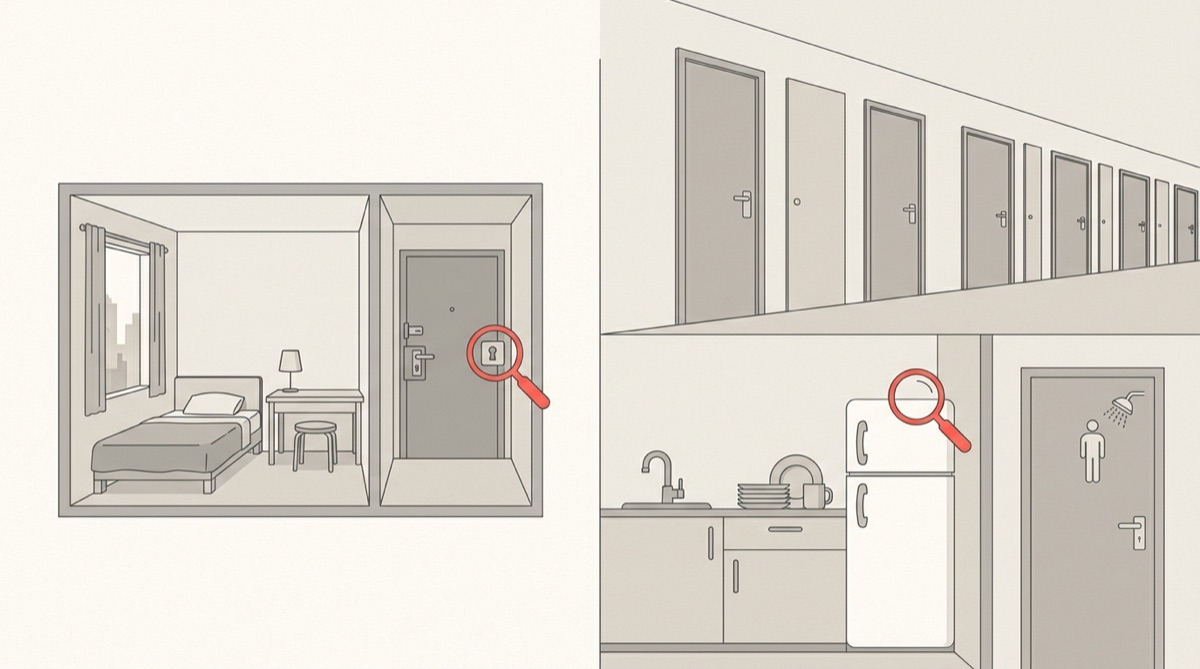 THE ROOMTHE BUILDING
Key takeaways
- A goshiwon is a licensed shared-living facility, not a small apartment. Most of what can go wrong lives outside your door — so inspect the building, not the room.
- Fire kit first: sprinkler heads in the room and corridor, a corridor that leads to an exit in a direction you can actually walk, and a fire-liability insurance certificate the manager can show you.
- Knock the wall. Hollow partition walls are the single most common regret we hear after move-in, and nothing about the photos will tell you.
- Count fixtures, not adjectives. Showers and toilets per floor, divided by occupied rooms on that floor, is the number that decides your mornings.
- Nothing is real until it is written: address, monthly fee, what is included, the refund rule, and whether you may register the address. Registered foreign residents must report a change of residence within 15 days of moving.
A goshiwon (고시원, literally 'exam-study hall') is the cheapest way to get a lockable private door in a Korean city, and for a 3–12 month stay it is often the rational choice. It is also the housing type where the listing photo tells you the least. The room is 100% of what you are shown and maybe 40% of what you will live with; the corridor, the shared bathroom, the wall between you and the next tenant, and the manager's rules are the rest. This checklist is written in the order you should physically walk it, and it assumes you get roughly thirty minutes on site.
It deliberately does not repeat our general viewing guide. Standard apartment-viewing questions — water pressure, mould, the landlord's registry extract, deposit protection — matter less here because a goshiwon usually takes little or no deposit and is contracted monthly. What replaces them is fire safety, shared-facility load, and acoustic construction.
What a goshiwon legally is, and why it changes the checklist
In Korean building law a goshiwon is classified as a 다중생활시설 (dajung saenghwal siseol, multi-household living facility) and is grouped with officetels and dormitories as 준주택 (jun-jutaek, 'quasi-housing') rather than as housing proper. That classification is not trivia: it is why your room may legally have no kitchen and no private bathroom, and why the building is regulated primarily through fire and facility rules instead of housing rules.2
Goshiwon operation is also a 다중이용업 (dajung iyongeop, publicly used establishment) under the Special Act on the Safety Control of Publicly Used Establishments. Operators carry duties that you can verify with your own eyes during a viewing: prescribed safety facilities including sprinkler provision, emergency exits and escape equipment, and mandatory fire-liability insurance. A building that cannot demonstrate these is either non-compliant or not actually a registered goshiwon.15
The four tiers you will meet in Seoul university belts.8
| Room grade you will see advertised | What it usually means | Check this hardest |
|---|---|---|
| 내창 (naechang, inner window) | Window opens onto the corridor or a light well, not outside. Cheapest tier. | Ventilation and whether the 'window' is frosted glass onto a hallway — smell the room after the door has been shut for a minute. |
| 외창 (oechang, exterior window) | A real window to the outside. Typically ₩50,000–100,000/month more. | Open it. Confirm it actually opens, and what it faces — an air-conditioner outdoor unit or a smoking spot ruins it. |
| 샤워실 포함 (private shower/toilet) | A compact wet-room inside your room. The top goshiwon tier. | Extraction fan working, drain smell, and whether the shower soaks the toilet paper every time. |
| 원룸텔 / 리빙텔 | Newer builds marketed above goshiwon; often the same legal category. | Ask the permit year. 'New interior' and 'new building' are different claims — the walls may still be old. |
What it costs
Figures as of 2026-08 · verify the live listing8
| 내창 room (no exterior window) | ₩300,000 – ₩420,000 | Shared bathroom. Usually the floor of the market. |
|---|---|---|
| 외창 room (exterior window) | ₩380,000 – ₩520,000 | Shared bathroom. The most common choice among our guests. |
| Room with private shower/toilet | ₩450,000 – ₩650,000 | The tier where a goshiwon starts competing with a small 원룸. |
| Newer 원룸텔 / 리빙텔 build | ₩550,000 – ₩780,000 | Better soundproofing is possible here but never assumed — still knock the wall. |
| Deposit (보증금) | ₩0 – ₩500,000 | Often zero. Anything above one month's fee deserves a written refund clause. |
| Utilities, wi-fi, rice/kimchi/ramen | Usually included | Air-conditioning in summer is the common exception — ask explicitly. |
These are ranges from HeartStay concierge cases, not a government statistic. Our intake skews toward Japanese nationals and toward the Sinchon–Hongdae belt, so other cities and other nationalities may see different numbers. Prices move; treat this as a sanity check, not a quote.
The 30-minute viewing walk, in order
- 01
1. Before you go in: find the entrance and the floor
Note which floor the goshiwon occupies and what is below it. A goshiwon above a restaurant, a bar or a PC room means kitchen exhaust, late-night noise, and one more ignition source under your bed. Look for the registration and business signage at the entrance rather than only the interior sign.
- 02
2. The corridor, before the room
Walk the whole corridor to both ends. You are answering one question: if the corridor filled with smoke, could you leave in two directions? Dead-end corridors, exits blocked with stored furniture, and doors chained shut are the failure pattern in every goshiwon fire report. Also note corridor width — if two people cannot pass without turning sideways, evacuation with luggage is theoretical.
- 03
3. Look up, twice
In the corridor and inside the room, look for sprinkler heads on the ceiling and for smoke detectors. Then find the escape equipment: an emergency descent device (완강기, wangangi) or an escape ladder, usually marked with a green sign. If you cannot see sprinkler heads anywhere, stop the viewing and ask the manager to show the safety-facility documentation.
- 04
4. The room: knock, then sit
Knock the wall you would sleep against. A hollow, drum-like sound means a gypsum-board partition; a dull, solid sound means masonry or concrete. Then sit on the bed in silence for sixty seconds with the door closed and listen. You will hear your future.
- 05
5. The room: sockets, air, light
Count power outlets and check whether the air-conditioner is individually controlled or a central unit the manager switches on by season. Confirm the room heats and cools independently. Check that the door locks from the inside and that the lock is not a knob you could open with a card.
- 06
6. Shared bathroom: count, then smell
Count showers and toilets on your floor. Ask the manager how many rooms on that floor are currently occupied and divide. Anything worse than one shower per six occupied rooms means queuing on weekday mornings. Check the drains for standing water, look at the grout and the ceiling for black mould, and confirm there is hot water at the time of day you would actually shower.
- 07
7. Kitchen and laundry: read the rules on the wall
The shared kitchen is where the house rules become concrete. Photograph the posted rules. Check whether cooking is allowed in rooms (usually not), whether the free rice/kimchi/ramen is genuinely unlimited, whether there is fridge space per person or one communal fridge, and how many washing machines serve the floor — plus whether they cost coins and whether there is a drying option in the rainy season.
- 08
8. The manager: ask the four questions
Ask, in this order: (a) Can I see the fire-liability insurance certificate? (b) Will you give me a written contract with the building address and your signature? (c) May I register this address as my residence? (d) If I leave after two weeks, what exactly is refunded? A manager who answers all four without friction is worth more than an exterior window.
Walls and noise: the complaint that arrives in week two
Goshiwon rooms are usually created by partitioning a larger floor plate, and the partitions are frequently gypsum board on a stud frame rather than masonry. The practical consequence is that you will hear your neighbour's phone alarm, their video calls, their keyboard, and their door. Corridor doors are often the loudest single object in the building because they are light and close hard. In our concierge intake of 801 web-form inquiries between July 2025 and August 2026, noise and hygiene were the two recurring themes in free-text goshiwon questions — and 68% of those inquirers listed goshiwon among their acceptable room types, so this is not a fringe concern. Our sample skews heavily Japanese, which likely raises sensitivity to noise relative to other groups.
Bathrooms, kitchen, and the rules you are agreeing to
Shared-facility quality in a goshiwon is a function of management, not of price. A ₩350,000 room in a well-run building beats a ₩550,000 room in a neglected one on every measure that affects daily life. The proxies for good management are visible in ten seconds: is the corridor floor clean, are the bathroom bins emptied, is the kitchen fridge free of unlabelled month-old containers, is there a posted cleaning schedule that has actually been ticked. Ask when the shared bathroom is cleaned and by whom — 'the tenants take turns' and 'daily by staff' produce very different Februaries.
Get these before you transfer any money
- Written contract or occupancy agreement Must show the full building address including room number, the monthly fee, the start date, and the operator's name and signature or stamp.
- What the fee includes, in writing Electricity, air-conditioning in summer, wi-fi, rice/kimchi, laundry. Verbal 'of course it's included' is the most common later dispute.
- Refund and notice rule How much notice you must give, and what happens if you leave mid-month. Ask for the actual arithmetic on a specific example date.
- Fire-liability insurance certificate Operators of publicly used establishments must carry it; it is often posted near the entrance. Photograph it.
- Written confirmation that you may register this address You will need a usable address for your residence report, bank, and deliveries. Some operators resist. Settle it before, not after.
- Receipt for the deposit and first month Transfer to an account whose holder name matches the operator name on the contract. A mismatch is a red flag worth a phone call.
- Photographs of the room and posted house rules Optional Taken on the day of the viewing, before move-in. Your evidence if the room you get is not the room you saw.
Ask whether the floor is women-only (여성 전용 층) — many buildings have one, and it is not always advertised in the listing. Then check the specifics that matter more than the label: is there a keypad or card at the building entrance as well as the room door, is the corridor lit at night, is the shower area lockable from the inside, and is the entrance route from the nearest station lit and populated after 10pm. Walk that route once at night before you sign. Safety was raised unprompted in 14% of the free-text fields in our 801-case intake, which is why we now ask about it before the viewing rather than after.
This is where a goshiwon is hardest to beat: little or no deposit, monthly terms, furnished, utilities included, and no need for a Korean guarantor or a bank account on day one. Prioritise the refund clause and the notice period over room quality — flexibility is the thing you are actually buying. Do not accept a discounted rate that requires prepaying six months; the discount is rarely worth losing the exit.
Compare against your university dormitory before committing to a semester. Dormitories are usually cheaper per month but impose curfews, roommates, and vacation closure periods — the closure is the detail that catches people, because it can leave you homeless for several weeks between terms. A goshiwon that is slightly more expensive but continuous across the break is often the cheaper year.
After you sign: the admin sequence
From contract to settled, in order
- Day 0 — viewing day Sign, pay, photograph Contract in hand, room photographed, posted house rules photographed, insurance certificate photographed. Save the operator's phone number under the building name.
- Day 0–1 — move-in Test what you could not test at the viewing Hot water at 8am, wi-fi speed in your room rather than the corridor, whether the air-conditioner is truly under your control, and the noise floor at midnight. Raise problems in the first days while you still have leverage.
- Within 15 days of moving Report your change of residence Registered foreign residents must report a change of residence within 15 days. Do it through HiKorea or at the competent office with your ARC and your contract. This deadline is a legal obligation, not a formality, and missing it can carry a penalty.
- Week 1–2 Address-dependent setup Bank account, delivery address, mobile plan if not already done. Korean residents register their address via 전입신고; the equivalent step for registered foreign residents is the residence report above.
See goshiwon and low-deposit rooms near Sinchon, Hongdae and Hoegi
Filter by monthly fee and walking distance to your station, then bring this checklist to the viewing.
Do I get deposit protection like a normal lease?
Usually the question does not arise, because goshiwon deposits are commonly zero or a fraction of one month. That is the trade: you skip the deposit machinery entirely. The practical rule is to keep any deposit at or below one month's fee and to insist on a written refund clause. If an operator asks for a large lump sum up front, you have left goshiwon economics and should be applying the checks in our scam red-flags guide instead.
Can I have a guest stay overnight?
Assume no unless the posted rules say otherwise. Most goshiwon prohibit overnight guests outright, and some charge or terminate for it. This is worth asking directly at the viewing rather than discovering through a confrontation in the corridor.
The room turned out unbearable after a week. Can I get money back?
Only to the extent your written refund clause says so — which is exactly why it is on the pre-payment checklist. Many operators refund on a pro-rata basis minus a deduction; some refund nothing after occupancy begins. If nothing was written down, you are negotiating from zero. Raise the problem in writing (a KakaoTalk message is fine) the day you notice it, so there is a record.
Is a goshiwon address good enough for a bank account and deliveries?
For deliveries, yes, provided you add your room number and agree with the manager where parcels are held. For banking, what matters is the address recorded on your residence card rather than the building type — which is why the written permission to register the address is on the checklist above. Branch-level document requirements vary, so bring your contract along with your ARC.
Should I book a goshiwon before I arrive in Korea?
For the first two to four weeks, a short-stay booking is reasonable — arriving with nowhere to sleep is worse than a mediocre room. But do not commit to six months sight-unseen. Almost everything in this checklist requires standing in the corridor. Book short, view in person, then commit.