Housing literacy
Goshiwon vs sharehouse vs oneroom: how to choose on a tight budget
The three cheapest ways to live in Seoul are not three price points — they are three different legal objects, with different paperwork, different deposit risk, and different rules about registering your address. A decision tree for stays of 3 to 24 months.
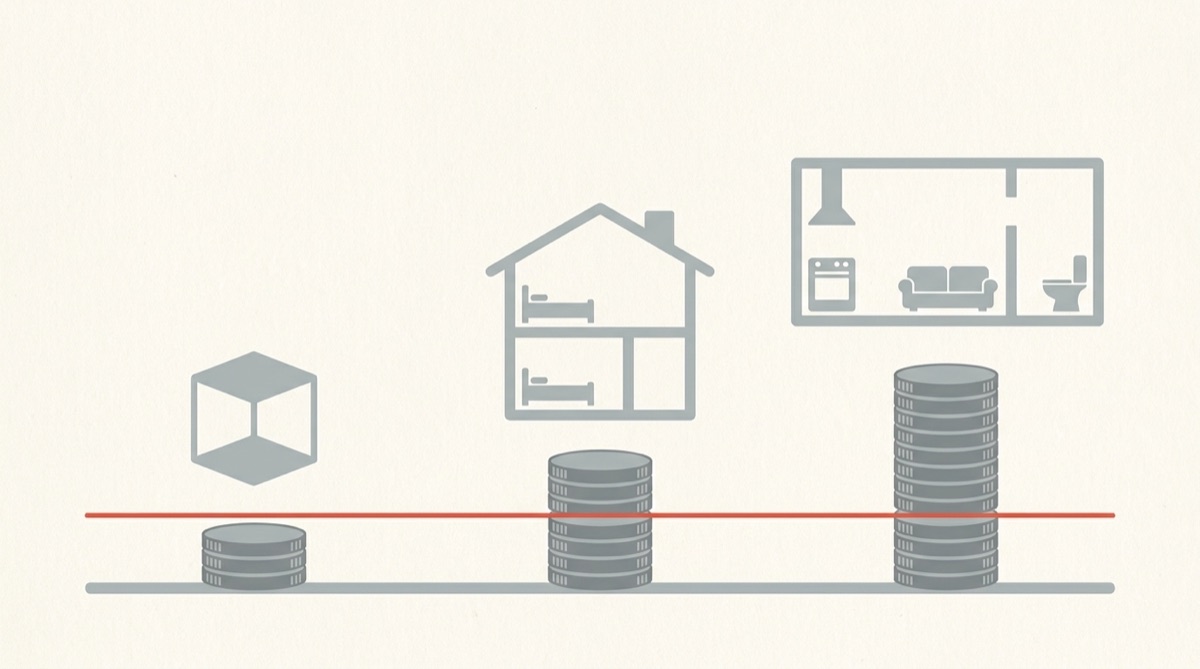 LOW CASHLOW RISK
Key takeaways
- Goshiwon, sharehouse and oneroom are not cheap / medium / expensive versions of the same thing. They are three different legal objects, and the price follows from that.
- If you can move less than about ₩2,000,000 into Korea before you have a Korean bank account, the honest shortlist is goshiwon or sharehouse. A central Seoul oneroom rarely opens below a ₩3,000,000 deposit.
- The question that decides more than budget: can you register your address there? Ask before you pay, and keep the answer in writing.
- Deposit safety is a procedure, not a feeling — dated written contract, address registration, property registry check. A goshiwon facility-use agreement usually gives you none of the three.
- Under 6 months, go month-to-month. At 12 months and beyond, a oneroom deposit starts paying itself back through lower monthly rent.
Almost every budget housing article for foreigners in Korea sorts these three by price and stops there. That ordering is real but it is the least useful thing about them. A goshiwon room and a oneroom differ in what you sign, who you can complain to, whether the Housing Lease Protection Act reaches you, and whether the address goes on your immigration record. Those differences decide whether ₩500,000 a month is a good deal or a trap — and they are all knowable before you pay.
Three products, three legal objects
A 고시원 (goshiwon) is legally a 다중생활시설 — a room inside a neighbourhood-facility building, not a registered dwelling. You sign an 이용계약 (iyong-gyeyak, facility-use agreement), not a lease. A sharehouse has no legal category of its own: in practice an operator holds the master lease on an ordinary apartment or villa and sublets rooms to you, which makes you a 전차인 (subtenant). A 원룸 (oneroom) or 오피스텔 is a dwelling leased from its owner under the Housing Lease Protection Act, normally through a licensed agent. Same city, same street, three different sets of rights.35
The differences that actually cost money are in the bottom four rows, not the top.35
| 고시원 Goshiwon | Sharehouse | 원룸 Oneroom / 오피스텔 | |
|---|---|---|---|
| What it is legally | 다중생활시설 — a room in a neighbourhood facility, not registered housing | No separate category; usually a sublease of an ordinary unit | A dwelling leased directly from the registered owner |
| What you sign | 이용계약 — often a single page, sometimes only house rules | Sublease or occupancy agreement with the operator | 표준임대차계약서 (standard lease), usually via a licensed agent |
| Typical term | Month to month | 1–6 months; 3-month minimum is common | 12 months standard |
| Furnishing | Bed, desk, mini fridge, shared kitchen and laundry | Furnished room plus shared living room and kitchen | Often empty or half-옵션 (partly fitted) |
| Private kitchen / bath | Rare; a private bathroom is a paid upgrade | Private room, shared kitchen and usually shared bath | Both private |
| Who you deal with | Owner-operator on site, frequently Korean only | Operator, often English- or Japanese-speaking | Landlord plus a licensed agent (공인중개사) |
| Address registration | Sometimes refused — must be confirmed in advance | Usually fine, still confirm | Standard and expected |
| Exit cost if you leave early | One month's notice, roughly | Notice period per operator, deposit at risk | Rent until a replacement tenant is found, plus a new agent commission |
What each actually costs
Figures as of 2026-08 · verify the live listing9
| Goshiwon — deposit | ₩0 – 500,000 | Many take no deposit at all; one month paid up front is the norm |
|---|---|---|
| Goshiwon — monthly | ₩350,000 – 650,000 | Utilities, wifi, rice and kimchi usually included. A window and a private bathroom are what move the price, not the floor area |
| Sharehouse — deposit | ₩300,000 – 1,000,000 | Refundable, but held by an operator rather than a property owner — see the deposit section |
| Sharehouse — monthly (private room) | ₩450,000 – 750,000 | A shared twin room runs materially lower; utilities are often split separately at ₩30,000–60,000 |
| Oneroom — deposit | ₩3,000,000 – 10,000,000 | Below ₩3,000,000 is rare in central Seoul. A larger deposit buys down monthly rent — worth it only if your stay is long |
| Oneroom — monthly | ₩450,000 – 800,000 | Same room, different deposit/rent splits are usually negotiable |
| Oneroom — 관리비 (maintenance fee) | ₩50,000 – 120,000 / month | Charged on top of rent and often excluded from listing prices. Ask exactly what it covers and what happens in winter |
| Oneroom — 중개보수 (agent commission) | one-time, capped by ordinance | Calculated on 보증금 + (월세 × 100), then a rate set by each metropolitan ordinance. Ask the agent to show you the rate table before signing |
| Any option — move-in kit | ₩150,000 – 400,000 | Bedding, kitchenware, drying rack, cleaning supplies. Goshiwon and sharehouse remove most of this |
Ranges reflect our own concierge pipeline and current listings in Seoul as of 2026-08. Regional cities run lower across every line. Treat these as planning figures, not quotes.
For scale against real demand: across 801 web inquiries we received between July 2025 and August 2026, the median monthly rent people asked for was ₩600,000 and the median deposit they could put up was ₩1,500,000. That median deposit sits in the gap — above what a goshiwon or sharehouse needs, below what a central Seoul oneroom will accept. That gap is where most people get stuck, and it is why the decision is rarely settled by price alone. (Our sample skews heavily toward Japanese nationals, so read it as our clientele, not as the market.)9
Four questions, in this order
- 01
How long will you actually stay — not how long you hope to?
Under six months, a 12-month oneroom lease is the wrong instrument. Leaving early normally means paying rent until the landlord finds a replacement tenant, and paying the new agent commission yourself. Around 12 months — the plan for 35% of our inquiries — the arithmetic flips and the deposit starts working for you. If your dates are genuinely uncertain, price that uncertainty as a real cost and stay month-to-month.
- 02
How much cash can you move before you have a Korean bank account?
Deposits are paid by domestic bank transfer, usually on or just before move-in day, and a foreign card will not do it. Opening a Korean account generally needs your Alien Registration Card, which arrives after you land. Under roughly ₩2,000,000 of movable cash at arrival, goshiwon and sharehouse are the realistic options — not because they are 'starter' housing, but because the timing works.
- 03
Do you need a registered address on record?
For a visa extension, a bank account, a phone contract on your own name, or a school that keeps your address on file, the answer is yes. That rules out any operator who will not let you register — regardless of how good the room is. See the next section.
- 04
Who do you need to be able to argue with, in a language you speak?
Something will break, or a neighbour will be loud at 3am, or a charge will appear that you did not expect. Sharehouse operators are usually reachable in English or Japanese. Goshiwon owner-operators usually are not. A oneroom puts a licensed agent between you and the landlord, which helps at signing and rarely afterwards. Be honest about which one you can actually handle alone.
Your first stay is short and your income is unstable for the first weeks. Take a sharehouse for two or three months, then move once you know where you actually work — Seoul commutes punish a wrong guess, and moving is far cheaper than breaking a lease.
Dormitory application deadlines usually close months before arrival, and missing one is the single most common reason students end up in a goshiwon. That is a reasonable bridge, not a failure — but check whether your school requires a registered address on file, because that constrains which rooms you can take.
Confirm in writing who holds the lease, who paid the deposit, and what happens to the room if you resign or are let go. If the deposit is the employer's, you have no claim on it; if it is yours but the lease is in the company's name, you have neither the room nor a straightforward way to recover the money.
The address test — settle this before you pay
Your registered address is not administrative hygiene. Holders of an Alien Registration Card must report a change of residence (체류지 변경신고) to an immigration office or the local 주민센터 within 15 days of moving, and that address is what banks, telecom operators and schools check against your record. If the room you take cannot be registered, you have not saved money — you have created a problem that costs more than the rent difference.123
What actually protects your deposit
The Housing Lease Protection Act attaches to actual residential use rather than to how a building is registered — which is why a goshiwon room can, in principle, fall inside it. But the protections are procedural, not automatic. 대항력, the right to assert your lease against a new owner, requires that you have taken possession of the unit and registered your address. Priority repayment additionally requires 확정일자, an official date stamp on your written contract. A one-page facility-use agreement with no address registration produces neither. That is the real difference between a ₩300,000 deposit and a ₩5,000,000 one: not the amount, but whether there is a mechanism behind it.34
There is a further layer for small deposits: the 소액임차인 최우선변제 rule repays a defined slice of a small deposit ahead of most other creditors if the building is auctioned, provided you met the possession-and-registration conditions in time. Most of our clients' deposits sit inside that bracket. The qualifying ceilings and the protected amounts are set by presidential decree, differ by region and are revised periodically — check the current figures at the law portal rather than trusting a number in a blog post, including this one.34
For an ordinary oneroom lease there is also a filing duty: leases above the reporting threshold — which most oneroom contracts exceed, since the monthly-rent trigger is low — must be reported to the local office within 30 days under the 주택임대차 신고제. The filing receipt confers 확정일자 automatically. It is the cheapest deposit protection that exists, and it is the landlord's duty as much as yours, so there is no reason to skip it.56
Before you transfer a single won
- 등기부등본 — certified property registry extract Oneroom and officetel: pull it yourself at IROS for a small fee rather than accepting the agent's printout. Check the registered owner's name and how much mortgage (근저당권) sits on the property.
- Owner's ID matches the contract and the bank account The name on the registry, the name on the contract and the account receiving your deposit must be the same person. If someone signs on the owner's behalf, ask for the power of attorney.
- Written contract, with 확정일자 or the 신고필증 Keep your own copy, not a photo of the agent's. Without a dated written contract, the priority-repayment mechanism does not exist for you.
- Written confirmation that you may register your address A screenshot of the chat is enough; a line on the contract is better.
- Owner's written consent to the sublease Sharehouse or any sublet: the Civil Act allows an owner to terminate a lease when the unit is sublet without consent, and you are the one who would have to leave. Ask the operator to show consent, or at least the master lease clause permitting it.
- 관리비 breakdown in writing What it covers, what is metered separately, whether it changes seasonally.
- Move-out terms Notice period, cleaning deduction, what the operator counts as damage versus wear.
- Timestamped photos of every existing scratch and stain Taken on move-in day and sent to the landlord or operator the same day, so the timestamp is in their inbox too.
The registry check and the sublease-consent question are the two items on that list people most often skip because they feel awkward to raise. Both are ordinary requests in Korea, both are answerable in a day, and both are the specific items that turn a deposit dispute from an argument into a document.37
Safety is not a soft criterion here
고시원업 is designated a 다중이용업 — a multi-use business subject to a dedicated safety statute imposing requirements such as sprinkler systems, emergency exits and escape equipment. That designation exists because of a history of fatal goshiwon fires, and the buildings to scrutinise hardest are those permitted before the rules were tightened. What to check on the tour, in order: two separate ways off your floor, a sprinkler head in the room and the corridor, corridor width you can pass someone in, and whether the exit stairwell is being used for storage. If the stairwell is full of boxes, leave.35
There is a related reason two goshiwon rooms at the same price can differ by half in size: the current building standard for newly permitted 다중생활시설 sets a minimum room area — around 7㎡ without a private bathroom, larger with one — but buildings permitted before it are not retrofitted. Older stock is legal and often cheaper, and it is where the tiny rooms in every viral photo come from.5
In our own intake, 14% of free-text inquiries raise women's safety without being asked. The recurring asks are a locked building entrance, CCTV covering the corridor, and a floor above ground level. Sharehouses tend to be strongest on this — entry codes, an operator on call, housemates who notice — and goshiwon the most variable, building by building. It is a fair thing to ask about explicitly, and any operator who is dismissive about it has told you something useful.9
See low-deposit rooms near Sinchon and Hongdae
Filter by deposit band to see where the goshiwon / sharehouse / oneroom line actually falls in each district.
Can I move from a goshiwon into a oneroom mid-semester without paying two rents?
Mostly yes. Goshiwon terms are month-to-month, and notice is usually one month or pro-rated by house rules — ask for the exact rule when you move in, not when you leave. Overlapping the two by a week costs far less than breaking a 12-month lease, and it lets you move in daylight instead of in one panicked evening.
Do these operators run credit or income checks on foreigners?
Goshiwon and sharehouse operators typically want your passport and your Alien Registration Card, or the application receipt if the card is still pending. Oneroom landlords ask more: the ARC, sometimes proof of income or enrolment, occasionally a guarantor. That last request is where most foreign applicants stall, and where an agency or concierge letter confirming your status and payment source does real work. In our concierge cases it is the most common reason a landlord's initial no becomes a yes.
Is an 오피스텔 just a nicer oneroom?
Not legally. An officetel is 준주택 — a unit that can be used for residence or for business — and the contract will specify which. The Housing Lease Protection Act reaches you when it is genuinely used as a residence, but a contract written as 업무용 (business use) complicates address registration and changes the tax treatment for both sides. Ask which type the contract is before you sign, and match it to how you will actually live there. Maintenance fees also run higher than a comparable villa oneroom.
What happens to my deposit if my visa is refused or my programme is cancelled after I have paid?
Nothing in a standard lease refunds you for that. With a goshiwon or sharehouse your exposure is roughly one month plus a small deposit; with a oneroom, the deposit stays locked until the landlord finds a replacement tenant, and you may owe rent in the meantime. If your arrival depends on an approval you do not yet hold, that asymmetry is the strongest single argument for starting month-to-month and signing a lease only after you are on the ground.