Cost literacy
The hidden costs nobody lists: what a Korean rental actually takes on day one
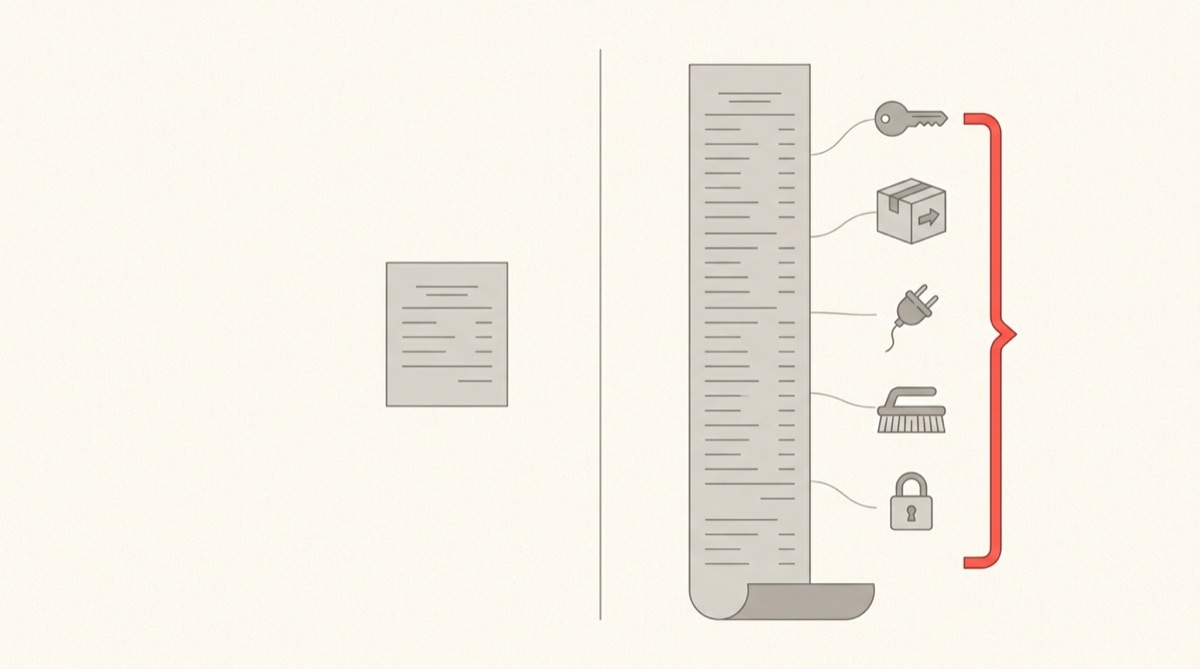
A listing shows two numbers. Your first month takes six. A line-by-line reconstruction of deposit, 관리비, agent commission, utilities and setup costs for a Seoul studio — with the formulas, the seasonal spikes, and what you can claim back on the way out.
 LISTEDPAID
Key takeaways
- A listing gives you two numbers. At HeartStay's median Seoul case — deposit ₩1,500,000, rent ₩600,000 — those two add to ₩2,100,000, while realistic day-one cash lands between ₩2,770,000 and ₩3,890,000.
- 관리비 (gwanribi, maintenance fee) is not a utility bill. In small buildings it is a flat figure the owner sets, and the 5% renewal cap in the Housing Lease Protection Act is written on rent and deposit — not obviously on this line. Fix it in writing before you sign.
- The agent commission is a formula, not a quote: (deposit + monthly rent × 100) × a capped rate, plus VAT. For the median case that is ₩270,600, payable once per contract.
- Month one is the cheapest month you will ever see. Gas and electricity lag a billing cycle, the first 관리비 is usually prorated, and the first heating bill arrives in December.
- Setup costs do not shrink with a short stay — they concentrate. Spread over three months they add roughly 43% to your effective monthly cost; over twenty-four months, about 5%.
Almost every rental listing in Korea, in any language, advertises the same two figures: 보증금 (bojeunggeum, the refundable deposit) and 월세 (wolse, monthly rent). Neither is wrong. Together they are roughly 60–70% of what actually leaves your account in the first month, and they say nothing about what leaves it every month afterward. Of the 801 inquiries HeartStay's concierge received between July 2025 and August 2026, maintenance fees came up unprompted in 41 — almost always after someone had already signed and been surprised. This guide reconstructs the whole number, line by line, so the surprise happens here instead.12
Day one: the number the listing does not print
Figures as of 2026-08 · verify the live listing31112
| Deposit (보증금) | ₩1,500,000 | Refundable at move-out, less agreed deductions. This is the median deposit across 801 HeartStay inquiries. |
|---|---|---|
| First month's rent (월세), prepaid | ₩600,000 | Korean rent is paid in advance, on the same calendar day each month. You never pay in arrears. |
| Agent commission + VAT (중개보수) | ₩270,600 | A capped formula, not a negotiated quote. Worked out below. |
| First maintenance fee (관리비) | ₩50,000 – ₩120,000 | Charged from day one, usually prorated for a partial first month — which makes it look smaller than it is. |
| Utility account transfer / meter reading | ₩0 – ₩50,000 | Normally just settling the previous tenant's closing balance. Insist on seeing the final readings on handover day. |
| Fixed-date stamp (확정일자) | ₩500 – ₩600 | The cheapest line on this table and the only one that protects the ₩1,500,000 above. |
| Move-in cleaning (입주청소) | ₩0 – ₩250,000 | Optional. Worth it for a unit handed over uncleaned; skip it if the landlord cleaned before handover. |
| Moving / freight (용달 or 포장이사) | ₩150,000 – ₩600,000 | ₩0 if you arrive from abroad with suitcases. The upper end is a full packing service across the city. |
| Bedding, kitchen basics, first shop | ₩200,000 – ₩500,000 | Lower for a 풀옵션 (full-option) unit that already has a bed, fridge, washer and induction hob. |
Deposit and rent are the HeartStay median; the remaining ranges are Seoul market observations from concierge cases combined with published fee schedules. They are planning figures, not quotes. Our sample skews Japanese-national and skews toward Sinchon, Hongdae and Ewha, so it under-represents outer districts.
Added up, the realistic range is ₩2,770,000 to ₩3,890,000 — between ₩670,000 and ₩1,790,000 more than the two numbers in the listing. If you are arriving on a fixed budget converted from another currency, that gap is the difference between a comfortable first month and borrowing from someone. Budget the top of the range and be pleasantly wrong.
관리비: the line that hides the most
관리비 is a building operating charge, not a utility bill. In a large apartment complex it is a regulated, itemized figure published monthly on a government disclosure site. In the 원룸 (one-room studio) and 빌라 (low-rise building) stock that most short-stay foreigners actually rent, it is a flat number the owner chose, covering whatever the owner says it covers. The same ₩60,000 can mean 'common-area lighting and rubbish collection' in one building and 'water, internet and rubbish collection' in the next. You cannot infer it. You have to ask, and you have to ask in a form that produces a written answer.7
Ranges are for a single-occupant unit under about 33㎡ in Seoul, observed 2025–2026.712
| Building type | Typical monthly 관리비 | Usually included | Usually billed separately | How much disclosure you get |
|---|---|---|---|---|
| 빌라 / 다가구 원룸 (low-rise, no elevator) | ₩30,000 – ₩70,000 | Common-area lighting, waste collection, stairwell cleaning, sometimes water | Electricity, gas, internet | None by default. A flat figure set by the owner. |
| 오피스텔 (officetel) | ₩80,000 – ₩200,000 | Elevator, security, common-area power, cleaning, often water and internet | Electricity, gas | A building management office issues a monthly statement. Ask for the last three. |
| 아파트 (apartment, large complex) | ₩100,000 – ₩250,000 | Itemized: security, cleaning, elevator, long-term repair reserve | Electricity and gas appear itemized on the same combined bill | Published monthly on K-apt, the government disclosure system. Look up the complex before you sign. |
| 고시원 (goshiwon) | Not charged separately | Everything — electricity, gas, water, internet, and usually rice and kimchi | Nothing | None, and none needed. The monthly fee is genuinely all-in. |
Utilities: who bills you, when, and where the spike comes from
Utilities in Korea are billed by separate national or municipal providers, on different cycles, and — critically — with a lag. Electricity and gas bills reflect the previous month's meter reading, so your first true monthly cost only becomes visible in month two. Water in Seoul is billed every two months, and in many small buildings it is not metered to your unit at all but split across tenants inside 관리비.910
Figures as of 2026-08 · verify the live listing91012
| Electricity — Apr–Jun, Sep–Nov | ₩20,000 – ₩45,000 | Baseline: lighting, fridge, laptop, no climate load. |
|---|---|---|
| Electricity — Jul–Aug, air conditioning | ₩40,000 – ₩90,000 | Residential electricity is priced in progressive tiers. Summer tier boundaries are widened, but continuous air conditioning still pushes a studio into the top tier. |
| Electricity — Dec–Feb, if hot water or heating is electric | ₩70,000 – ₩180,000 | The single most common bill shock in our concierge cases. See the warning below. |
| City gas (도시가스) — Apr–Oct | ₩3,000 – ₩12,000 | Cooking and hot water only. |
| City gas — Dec–Feb, individual boiler (개별난방) | ₩60,000 – ₩150,000 | Poorly insulated 원룸, top-floor 옥탑 and 반지하 units sit at the top of this range. |
| Water (수도) | ₩8,000 – ₩20,000 per month equivalent | Seoul bills every two months. In most 다가구 buildings there is one meter for the whole building, so your share arrives inside 관리비 instead. |
| Internet (인터넷) | ₩0 – ₩40,000 | ₩0 where the building supplies shared internet inside 관리비. Otherwise a contract line — read the warning below before signing one. |
| KBS television licence fee (수신료) | ₩2,500 | Collected on the electricity bill. If the unit genuinely has no television, you can apply to KEPCO for exemption. |
These are observed monthly bill totals, not tariffs. National electricity and gas unit rates change on their own schedule; actual bills swing widely with insulation quality, floor level, glazing and heating type. Treat the winter rows as the ones worth stress-testing your budget against.
The agent commission is a formula, not a quote
Brokerage fees for residential leases are capped by law, with the ceiling set in each municipality's ordinance. The ceiling is a maximum, not a price — it can be negotiated downward, and in a slow month it sometimes is. What is not negotiable is the arithmetic behind it. First the lease is converted to a single 거래금액 (transaction value): deposit + (monthly rent × 100). If that total comes to less than ₩50,000,000, it is recalculated as deposit + (monthly rent × 70) — which is where most foreign short-stay leases land. The resulting figure selects a rate band, and some bands carry an absolute cap.311
Residential lease (주택 임대차), Seoul ordinance. These are ceilings. VAT is charged on top — 10% where the agency is a standard taxpayer, less for a small-scale taxpayer.311
| Transaction value (거래금액) | Maximum rate | Absolute cap |
|---|---|---|
| Under ₩50,000,000 | 0.5% | ₩200,000 |
| ₩50,000,000 – under ₩100,000,000 | 0.4% | ₩300,000 |
| ₩100,000,000 – under ₩600,000,000 | 0.3% | None |
| ₩600,000,000 – under ₩1,200,000,000 | 0.4% | None |
Worked examples. Run your own numbers before the handover and bring the figure with you — a quoted amount above your calculation is a conversation, not a fact.312
| Deposit / monthly rent | Transaction value | Band applied | Commission | With 10% VAT |
|---|---|---|---|---|
| ₩3,000,000 / ₩400,000 | ₩31,000,000 — the ×70 rule applies | 0.5%, cap ₩200,000 | ₩155,000 | ₩170,500 |
| ₩1,500,000 / ₩600,000 — HeartStay median | ₩61,500,000 | 0.4%, cap ₩300,000 | ₩246,000 | ₩270,600 |
| ₩10,000,000 / ₩700,000 | ₩80,000,000 | 0.4%, cap ₩300,000 | ₩300,000 — capped down from ₩320,000 | ₩330,000 |
The move-in extras
The rest of the setup spend is unglamorous and easy to under-plan: a small truck or a packing service, a move-in clean if the unit was handed over dirty, and the first shop for bedding, cookware and cleaning supplies. None of it is hidden in the sense of being concealed — it is hidden in the sense that nobody puts it next to the rent, so it never enters the comparison. Put it in the comparison.
Short stays cost more per month — mechanically
The commission, the move, the clean and the first shop are one-time costs attached to the act of moving, not to the time you spend in the room. Divide them by the number of months you will live there and the picture changes sharply. This is the strongest financial argument for the twelve-month default, and the reason a three-month lease at a lower headline rent is often the more expensive choice.12
Worked from the day-one table: setup cost ₩870,000 = agent commission ₩270,600 + a ₩600,000 midpoint for moving, cleaning and first-shop. Base = ₩600,000 rent + ₩70,000 관리비. Utilities are excluded because they scale with time rather than with the move. Across our 801 inquiries, 35% intended to stay about twelve months — the band where this premium first becomes tolerable.12
| Length of stay | Setup cost per month | Effective monthly cost | Premium over rent + 관리비 |
|---|---|---|---|
| 3 months | ₩290,000 | ₩960,000 | +43% |
| 6 months | ₩145,000 | ₩815,000 | +22% |
| 12 months | ₩72,500 | ₩742,500 | +11% |
| 24 months | ₩36,250 | ₩706,250 | +5% |
The ₩600 line item that protects ₩1,500,000
Of everything on the day-one table, one entry costs less than a coffee and does more than all the others combined. A Korean tenant's deposit is protected by two things acting together: 대항력 (opposability — you have possession of the unit and a registered address there) and 우선변제권 (priority repayment — a dated stamp on your contract that puts you ahead of creditors registered later). Registered foreign residents get the first through the change-of-residence report that immigration law treats as standing in for the resident registration a Korean tenant files, and the second through the 확정일자 stamp, which costs ₩500–₩600. Skip either and your deposit is an unsecured claim.145
- 01
Before signing: match the landlord to the register
Pull the 등기부등본 (property register) for the address — any agent can print it, and it is available online for a small fee. The name on it must match the ID of the person signing and the bank account you transfer to. Photograph both side by side. A deposit paid to a name that is not on the register is the single most expensive mistake available to you.
- 02
Signing day: pay the down payment, keep the original contract
The 계약금 (down payment) is customarily around 10% of the deposit and is paid at signing; the balance is paid on move-in day. Transfer to the owner's own account — never to an agency's personal account or an individual's account 'on behalf of' the owner. Keep the original signed contract; you will need the physical document for the stamp.
- 03
Move-in day: take possession and take photographs
Protection begins only once you actually hold the unit and have registered your address there — not from the signing date. On the same day, photograph every wall, floor, window frame and appliance, plus the electricity, gas and water meter readings. This set of photos is the entire evidentiary basis of your deposit return argument later.
- 04
Within 15 days: file the change-of-residence report
Registered foreign residents must report a change of residence within 15 days of moving in. It is free and can be filed at the local 주민센터 (community service centre) covering your new address or at an immigration office. Bring your residence card, the lease contract, and your passport. Do this even for a short stay — it is what converts your contract into a protected tenancy.
- 05
Same visit: get the 확정일자 stamp
Hand the original contract across the same counter and ask for 확정일자. It costs roughly ₩500–₩600 and takes minutes; it can also be filed online through the Supreme Court's internet registry office. Do it on the same day as the residence report so both protections start together. Photograph the stamped page immediately and store it somewhere that is not only your phone.
- 06
Afterward: hold proof of the registered address
Request a 외국인등록사실증명 (certificate of alien registration) showing the new address, and keep it with the stamped contract. If a dispute over the deposit ever reaches a formal process, these two documents are what you produce.
What you get back on the way out
Move-out is where the hidden costs run in the other direction — money you are owed and will not receive unless you ask for it specifically, with paperwork. Work through this before you hand back the keys, not after.
Move-out: what you are owed, and what proves it
- The deposit, less agreed deductions 원상복구 (restoration to original condition) covers damage you caused, not ordinary wear from living somewhere. Your move-in photograph set is what separates the two. Send it to the landlord alongside a matching set taken on your last day.
- Long-term repair reserve (장기수선충당금) Optional Apartments only. This reserve is legally the owner's cost, but it is collected each month on the tenant's maintenance bill, so tenants routinely pay it and never reclaim it. Ask the building management office for a statement of the total collected across your tenancy and claim that amount from the owner at move-out. It does not apply to 빌라, 원룸 or officetels, which are governed differently — do not claim it there.
- Unused prepaid rent Optional Rent is prepaid. If you leave part-way through a paid cycle by agreement with the landlord, the remaining days are yours. State the figure explicitly in writing rather than assuming it will be netted off.
- Closed utility accounts with zero balances Call each provider on your final day, give the closing meter readings, settle to zero, and send the landlord screenshots. Skip this and a lump sum is routinely withheld 'for utilities' — an amount that rarely bears any relation to the actual final bills and rarely comes back in full.
- Final maintenance fee settlement Ask for the prorated 관리비 figure for your final partial month in writing before handover, so it cannot be recalculated upward afterward.
- Dated record of key and door-lock handover Optional Message the landlord a photograph of the returned keys with the date visible, and note the door-lock code reset if you changed it. Lock replacement is a common and often unjustified deduction.
Much of this table collapses. A 고시원 or a share house is booked directly with the operator, so there is usually no brokerage commission at all, no separate 관리비, no utility accounts in your name, and no move-in shop — the monthly fee is genuinely all-in. Against that, you give up the deposit protection this guide's step list describes, because many such arrangements are not structured as protected residential leases. The trade is real and it is a trade: lower total cost, thinner legal position. Read it against the amortization table above — for a three-month stay, the all-in option often wins on arithmetic alone.
Two things change. Your 관리비 will be the largest recurring line after rent — budget ₩80,000–₩250,000, not ₩50,000 — but it will also be itemized, which means you can audit it. For apartments, look the complex up on K-apt before you sign and read the actual published monthly figures for the building rather than trusting the agent's estimate. And for apartments specifically, remember the long-term repair reserve on the move-out checklist above: over a two-year tenancy it is frequently a six-figure sum sitting unclaimed.
When the money actually leaves your account
- Signing day Down payment (계약금), customarily around 10% of the deposit Bank transfer to the registered owner's own account. Get a receipt or keep the transfer confirmation.
- Move-in day Deposit balance + first month's rent + agent commission with VAT The commission falls due at handover, not before. Ask for a 현금영수증 (cash receipt) — you are entitled to one and it creates a record of what you paid.
- Within 15 days of moving in Change-of-residence report (free) and 확정일자 (₩500–₩600) One visit, one counter, both done.
- Around day 25–30 First 관리비 bill — usually prorated Small, and therefore misleading. Multiply it out to a full month before drawing conclusions.
- Month 2 First full electricity, gas and water bills This is the first month that shows your real recurring cost. Recheck your budget here, not in month one.
- Your first December Heating Add ₩60,000–₩150,000 a month through February for gas heating — considerably more if hot water and heating are electric.
- Two months before the lease ends Notice of departure Give written notice in the window your contract specifies. Late notice is how a lease renews itself and a deposit stays where it is.
Browse Seoul studios with the maintenance fee shown up front
Sinchon, Hongdae and Ewha — the three stations most requested in our concierge inquiries.
The listing says 관리비 별도 (maintenance fee separate) with no number. How do I get a real figure before I view?
Ask the agent, in writing, for two things: the flat monthly amount and an itemized list of what it does and does not include. Korean listing rules require agents to disclose what a flat maintenance fee covers rather than leaving it blank, so this is a request you are entitled to make. If they will not answer, ask instead for the previous tenant's last three maintenance statements. If neither arrives, treat the unit as having an unknown monthly cost and price it at the top of the range in the table above when comparing.
I found the room myself on a listing site. Do I still owe the agent a commission?
If a licensed agent brokered the contract — introduced the unit, arranged the viewing, drafted and witnessed the agreement — the fee is due regardless of where you first saw the photographs. What you can do is check the calculation against the formula above, ask for the fee to come down from the ceiling rather than sit at it, and require a cash receipt. What you cannot generally do is have the contract brokered and then decline to pay for it.
The landlord wants the deposit in cash, or transferred to a family member's account. Is that normal?
No, and it is the point at which to stop. Pay only by bank transfer, and only to an account in the name printed on the property register. If the registered owner genuinely cannot receive it — they are abroad, or the property is managed under a power of attorney — ask to see the notarized authority document and verify it before transferring anything. A landlord who cannot produce that has not given you a reason to take the risk.
Can I negotiate the maintenance fee down?
Rarely the amount itself, because in a small building it is set uniformly across all the units and dropping it for one tenant creates a problem for the owner. What is very often available is a cap: an owner who will not reduce ₩70,000 to ₩50,000 will frequently agree in writing that it stays at ₩70,000 for the whole contract term. That written cap is worth more over twelve months than the discount you were asking for, and it costs the owner nothing today — which is exactly why they say yes.