Housing literacy
Which Seoul Neighborhoods Feel Safest at Night—and What “Safe” Means Locally
There is no honest Seoul safety league table for renters. Learn how to shortlist areas, test the route to one exact building after dark, and decide what “safe enough” means for your routine.
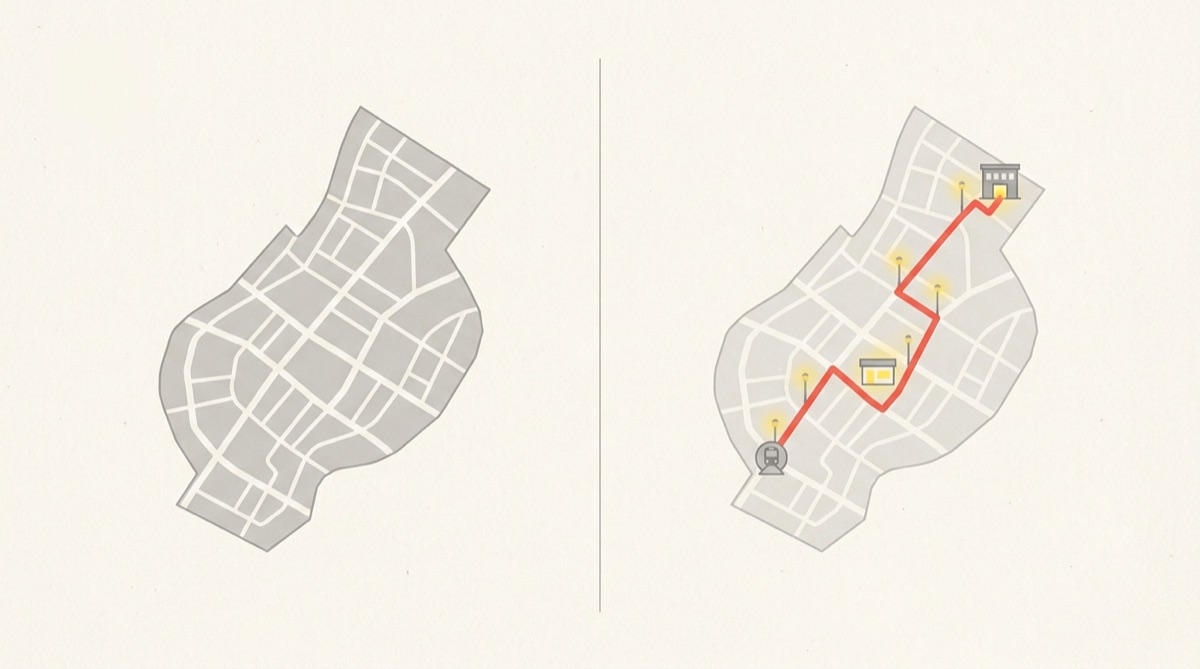 AREAROUTE
Key takeaways
- No Seoul neighborhood is honestly “the safest” for every renter. A ward, a station, and a building entrance can produce very different night walks.
- Treat the route from your usual station exit to the apartment door as part of the home. Test it at the hour you will actually return.
- A lively street can make the first half of a walk feel easy while the final turn becomes empty, steep, poorly lit, or hidden from view.
- Shortlist areas by your routine—campus, work, late transport, and tolerance for noise—then reject individual buildings that fail the night-route test.
- Use public safety tools as a backup layer. They do not replace a route and building entrance you can use comfortably on your own.
You are standing outside a station with your phone nearly flat, your luggage delivered to a temporary room, and a broker has sent one more listing. The neighborhood name sounds reassuring. That is not enough information to sign a lease.1
For a long-stay renter, “safe” should mean something practical: you can repeat the trip from your normal station exit or drop-off point to your own locked door at the time you normally arrive, without relying on luck, a crowd, or a route you would avoid alone. Official statistics are useful context, but they cannot certify one building’s final approach at one hour; Korea’s official statistics portal itself separates crime and safety data into broader statistical series, not a night-walk score for each listing.1
Use neighborhoods as starting points, not safety rankings
Functional shortlists for a night-route test—not a league table of “safe” districts
| Search zone | Why it may fit your routine | The test that decides it |
|---|---|---|
| Jamsil / Seokchon / Songpa | Start here if you want a residential base and a simple station-to-home routine. | Walk from the station exit you will use after dark. Check whether the route stays clear all the way to the building entrance, rather than ending in a detached parking lane or back street. |
| Edae / Sinchon | Start here if campus access and everyday walkability matter, and you can accept activity and noise nearby. | Follow the route after the main street thins out. A room can be close to campus yet require a quiet final climb or a turn through narrow side streets. |
| Hapjeong / Yeonnam edge | Start here if late errands and active streets matter, but you do not want to live inside the nightlife core. | Visit at your likely return time. Decide whether the crowd makes you feel visible and comfortable, or whether noise, intoxicated passersby, and late closing traffic would wear you down. |
| Wangsimni / Haengdang | Start here if transport connections shape your daily life. | Do the walk carrying what you would carry home. Check stairs, slopes, gate access, and whether the fastest route is also the route you would choose late at night. |
- 01
Get the exact route before you book a viewing
Ask the agent, “Please send the building pin, the entrance photo, and the station exit you recommend after 10 p.m.” A listing photo and a neighborhood label do not show the last turns; if the answer stays vague, treat that as a reason to view in person before paying any deposit.
- 02
Walk it at your real arrival hour
Choose the time you expect to come home, not a convenient afternoon slot. From the station or bus stop, walk without navigation for part of the route and notice where you would hesitate, cross unnecessarily, or lose sight of other people and open businesses.
- 03
Test the building, not only the street
At the entrance, ask, “Which door do residents use after midnight, and does every entrance require a key or code?” If there is a back entrance, open parking access, or a side gate you would need to use alone, include that in the decision rather than assuming the main lobby represents the whole building.
- 04
Choose the route you would repeat when tired
After the viewing, write down one sentence: “I would / would not be comfortable doing this walk alone after a late shift.” If your answer depends on calling a taxi every time or waiting for a friend, the location does not fit your normal routine—however attractive the room looks in daylight.
A one-evening viewing protocol
Run this on every serious listing
- Before leaving Set your real destination Save the building pin and your usual station exit, not only the neighborhood name. Tell the agent, “I want to check the walk from this exit to the entrance after dark,” so the viewing is built around the decision you actually need to make.
- At the station Take the route you would use alone Do not let a car ride replace the test. Notice which shops remain open, where the pavement changes, and whether you can still orient yourself if your phone fails or you miss a turn.
- At the final approach Pause before the building Look back toward the station and then toward the door. Ask yourself whether you could explain your location clearly, enter without waiting outside, and leave quickly if the entrance felt wrong.
- Inside and immediately outside Check every night-time access point Ask to see the lobby, building entrance, elevator or stairwell, and any rear or parking-side access. If an agent says a route is “fine,” follow with, “Would you use this entrance alone after midnight, and why?”
- After the viewing Compare notes, not impressions Record the route, entrance, lighting, noise, and your discomfort points while they are fresh. A listing that needs several excuses is usually a weaker choice than one whose route works without explanation.
Make your expected arrival time the first filter, not an afterthought. A flat that works at 7 p.m. but forces a taxi ride or an uncomfortable walk after your usual late shift is not a convenient home; pay attention to the return journey before comparing room size.
Compare station exits and the final walk before viewing
Use the map to plan an after-dark route test for every listing. The pin is a starting point for comparison, not a safety rating.
Questions renters ask after the first viewing
Is a well-lit street enough?
No. Lighting helps you see and be seen, but the decision also includes the final entrance, access control, whether you can orient yourself, and whether the route works at your real arrival time.
Should I avoid every nightlife area?
Not automatically. Some renters prefer the visibility and late services of active areas; others find the noise and crowds exhausting. Decide from a night visit to the exact block, not from the district’s reputation.
Does CCTV make a building safe?
CCTV can be one useful layer, but it does not replace a secure entrance, a route you can use comfortably, or an emergency plan. Treat it as supporting infrastructure rather than proof.
What should I do if I feel unsafe on a route after moving in?
Move toward a staffed, public place, contact emergency services if there is immediate danger, and use the safety tools you set up in advance. Then change the routine: choose a different exit, use a safer drop-off point, or avoid the weak part of the route rather than normalizing it.